

When you’ve powered referral marketing programs for over 350 of the World’s leading brands across telecommunications, insurance, utilities, credit cards, gaming, retail and more and across 27 countries and in 21 languages, it’s really difficult to distill all you learned into a short document. That’s why our Referral Marketing Best Practice Guide, at 18 pages, might seem a little daunting. So, we have distilled some of the key elements for referral marketing success into this blog.
As you will see, a lot of what we have written below is common sense, but you might be surprised just how often these principles are forgotten.
- Choosing the Right Software
- Think About the Incentives and Rewards
- Reduce the Friction
- Marketing Your Referral Program
- Refresh Your Program
- Test, Measure, Iterate
- Work with the Experts
Choosing the Right Software
The first thing to say is that success in referral marketing isn’t just about the software. While choosing the right software is very important, you must also support the program with the appropriate marketing tactics and assign the right people to look after and nurture your program, both from launch and throughout its whole lifetime. Otherwise, it may just wither on the vine and be consigned to the graveyard of other good marketing ideas that never got the support and attention they needed.
Despite having just said that success isn’t just about the software, if you don’t have the right referral marketing software to start with, then you’re unlikely to be successful. So, as a first step, these are some of the the key factors you need to consider when choosing your referral marketing solution:
Can you track all different kinds of referrals?
Can you track both online and offline? Particularly, if you want to drive online traffic in-store. Or maybe you don’t want to drive sales immediately, but instead want to track sign ups to mailing lists, app downloads, free trials or other actions? As referral marketing can be used in a number of different ways, your referral marketing software should be capable of tracking all of these actions.
Hear from David Hixon, Executive Director – Head of Product & Lifecycle Marketing at Ally Bank as to why banking referral programs need to keep customer information confidential:
How to manage referrals and customer privacy | Ally Bank
How to manage referrals and customer privacy | Ally Bank
Robin Bresnark: "So, let's talk about the actual mechanics of your program. It's a flat US$100 for the new customer?"
David Hixon: "That's right. The new customer that comes in can open either a savings account or a spend account, which is what we call our checking account. And in order to get that US$100, the savings account needs to either set up with a recurring transfer or on the spend account side, they need to set up direct deposit.
We monitor those accounts every day. When we see that behavior happen, we put the money in their account and
pay them and move on. It's a seamless fulfilment process.
The referrers get US$50 up to five referrals, so up to US$250.
And what's interesting about our program, the existing customer gets paid when the new customer opens and funds their account. So, I'm really only asking existing customers to get their friend to open an account, not to become a quality account."
Robin Bresnark: "Okay, that's really interesting. I've introduced Maggie. Maggie's opened an account. Maggie hasn't then performed the actions that Maggie needs to perform. But I've done everything I can do. You as a bank, you can't go to [me] and say [Maggie] hasn't done this yet."
David Hixon: "You're right in that there's so much that I want to tell you, but I'm very limited in what I actually can tell you.
I can't tell you that you referred David and he opened an account with $1 and then he went and closed it.
Obviously we can't share that type of information. So, we're trying to tow that line between creating that really personalized experience so that you can keep track of your progress without breaking any privacy rules along the way."
See the full interview here.
Does your software allow customers to share in all the ways they want to, while complying with all relevant legal requirements?
If your software limits the number of sharing channels that can be used, you’ll likely get less referrals from your program. Also, if you force your customers to type in their friends’ personally identifiable data, like email addresses, in order to share, then you could be in breach of personal data protection laws like the EU’s GDPR, California’s CCPA, Brazil’s General Data Protection Law and other relevant regulations. So make sure your software allows your customers to share using all their favourite apps and sharing channels while complying with all applicable laws.
“I’m very limited in what I actually can tell you [as a referrer]. I can’t tell you that you referred David and he opened an account with $1 and then he went and closed it. Obviously we can’t share that type of information. So, we’re trying to tow that line between creating that really personalized experience so that you can keep track of your progress without breaking any privacy rules along the way.”
David Hixon, Executive Director – Head of Product & Lifecycle Marketing at Ally Bank
Does your software allow you to identify and treat top referrers differently?
Why would you treat all referrers the same way, when often less than 20% of sharers will bring you over 80% of all referred new customers? Your software should be able to identify your super advocates and offer them extra incentives to share again and again.
Are you protected against fraud and self referral?
Unless your software can protect against you against fraud or self referral, you could be literally throwing money out of the window; paying out rewards for products that are later returned, or for bank accounts that are opened but never used etc.
Can you keep your program fresh?
Unless you update your referral program from time to time, it’s likely to become stale and boring, and performance will start to drop off. So, being able to update your rewards, incentives, copy and imagery quickly and without fuss, and be able to keep it in line with the look and feel of your website and your other marketing campaigns, is essential.
Can you test every element of your program?
If you are not constantly testing, learning and iterating then you will just be running your referral program based on assumptions and hunches, probably those of your HIPPO. Make sure your software lets you test different ideas and hypotheses, so you can base decisions on data and evidence.
Can you internationalise your program?
Even if you are not selling outside your home country today, who’s to say that won’t change in a few years? So your software should be able to cope with different currencies and languages, and even right-to-left writing.
Is your program responsive on mobile?
When more than half of the sharing can be expected to take place on a mobile phone, it simply isn’t an option to have a program that isn’t fully responsive across all devices. You can’t compromise on this.
Is it fun?
Does your software allow you to introduce fun elements like gamification, milestone rewards and visualisations of completion? If not there’s a risk that the entire process quickly becomes cold and dry. So, make sure your software allows you to add in some fun elements and gamify to drive increased referrals.
Hopefully you answered yes to all or almost all of the above questions. But if not, we’d love to have a chat with you on how Buyapowa deals with each of these elements. Now let’s move on.
Hear from Asya Kuznetsova, Product & Growth at Wise as to how to determine which referral rewards will motivate your customer base.
Which Referral Rewards Should You Offer | Wise
Asya Kuznetsova: "So I guess the most important bit, and this is a very product perspective, you need to understand your customer segments, and you need to actually go and talk with them and just [ask]: [why] do you recommend my product, for what action?"
"You need to very clear understand why they're recommending your product and for what, and what could be the right incentive for them. For most people, cash would be a good incentive. But of course if we look at more upscale segments and premium products, cash is no longer motivation there. Early access to features or some premium services could be."
"There is a category of users, that is hardest to identify, who are not interested in any rewards they just want to share the love for the product, and they want to give benefits to others. And for this category, using cash or any other incentive would not work."
See Full Video
Think About the Incentives and Rewards
Once you’ve decided that you’ve the right tools for the job, then you need to think about the incentives and rewards you should offer. When you consider our recent Reward Revolution Research found that 74% of people would be less likely to refer a friend if there was no reward and 70% of respondents said that they wouldn’t act on a referral without a friend incentive, then you can’t afford to get this wrong.
“You need to understand your customer segments, and you need to actually go and talk with them…you need to very clearly understand why they’re recommending your product and for what, and what could be a right incentive for them. For most of the people, cash would be a good incentive, but if we look at more upscale segments and premium products, cash is no longer a motivation. Early access to features or some premium services could be.”
Asya Kuznetsova, Product & Growth – Wise
The best place to start is by working backwards from your desired outcome and plot everything out from there. Ask yourself what you really want people’s friends to do. Do you want them to:
- Make their first purchase?
- Spend over a certain amount?
- Purchase specific brands or product types?
- Purchase in a physical store?
- Or, where your product is more of a considered purchase, simply get people into your sales funnel by signing up for emails, downloading an app or signing up for a free trial?
Obviously, your software must be able to track all these actions. But, once you’ve decided what you want referred-in customers to do, you can think about the value of that action compared to the effort and/or expense required from your customer and the referred-in friend.
As highlighted by research from the Universities of Yale and UC Berkeley, referral rewards are designed to overcome the psychological barriers your customers have; namely that there are other things they could do with their time, and the fear of losing social currency if a recommendation turns out to be bad. So the benefit or reward for your customer must ‘outweigh the cost of talking’. Research from Harvard also found that the incentive for the friend is also important for your customer due to the reputational benefits of rewarding social connections. The Yale research, mentioned above, also pointed out that offering a discounted price or gift with purchase means that there is an opportunity cost of not referring your friend.
Of course, you should also look at what your competition is offering, and also pay attention to what you are offering in different channels. Your refer-a-friend offer is unlikely to be very successful if, for example, it is widely known that you currently have a better deal on offer on a voucher code site.
Overall, we tend to see that almost two thirds of our retail clients use percentage discounts to incentivise new customers to shop. This avoids them having to apply a minimum spend (which sometimes looks ungenerous), and it’s simple to implement with their existing ecommerce technology. Meanwhile, 55% of our clients reward referrers with store credit. Again, it’s easy and practical, plus it has the added benefit of driving repeat purchases from existing customers.
Outside of retail, where it’s harder to give a reward linked to the product other than bill credits or free months etc., we see that often cash or cash equivalents, such as Amazon vouchers or other gift cards, are often offered as rewards and incentives by banks, insurers, energy and telecoms companies. Although telecoms and streaming businesses often offer a free month of subscription or an extra month’s free SIM card.
If you’d like to know more about rewards and incentives, we dive more deeply into the subject here.
As we’ll see in the next blog articles, the only sure-fire way to find out what rewards and incentives work is just to keep on testing with your customer base. So be sure to use a platform that lets you test, measure and iterate until you get it right.
Reduce the Friction
As Steve Krug advocated in his seminal book ‘Don’t make me think’, a good user experience should let customers accomplish their intended tasks as easily and directly as possible. Basically, you shouldn’t get in their way or make them stop and think further about what they came to do. Because if you do, then they might just change their minds.
Referral marketing, like other digital marketing channels, requires that you capture people’s attention, get them to click, minimise drop out and then encourage action. However, referral sales funnels can be longer than for a simple sale, particularly as you need to consider at least two actors: the referrer and the referred-in friend.
With a referral, there are four main stages where someone might ‘fall out’ of the funnel when:
- Your existing customers get involved
- Your existing customers share
- Their friends react to this sharing
- Their friends shop
And a break in any one part of that chain can lose the referral. This means you need to make sure each stage is as smooth and efficient as possible. You can do this by:
Asking less and delivering more
If your customers need to sign up to share, then the best advice is to keep your forms super-short, as every additional question increases the risk of drop out. However, ideally, you won’t even ask your existing customers to do anything at all by integrating with your own website’s universal login, or by pre-populating fields when users click through from seed emails, so that they can just share straight away with a few clicks using a personalised easy to remember URL or code.
Let users share however they want to share
When you consider that our Reward Revolution research found that 95% of respondents claimed to have referred at least one person to a brand in the past year, and that eight out of ten people want to refer their favorite brands, then you need to do everything you can to make it easy to share referral links and codes. So you should let your customers share however they want to by using any of the tools they normally use to communicate with friends such as email, Whatsapp, Viber, SMS, Facebook Messenger, Instagram, Telegram and any other social network or channel. Particularly on mobile phones, using native sharing to automatically open their favourite apps and letting them share in a couple of clicks will increase participation. Restricting sharing to just a few channels is literally just leaving money on the table.
Make them shop, not stop.
Think of the expectations of those who saw your customers’ messages recommending your brand with an enticing offer. When they click through, what will they see? Will your landing page look like what they expected to see? Will it repeat the offer? Will it look trustworthy? Will it even look like your brand?
Referred-in customers are looking for three things: trust, familiarity and efficiency. So, if possible, avoid microsites and embed the experience on your regular website to increase trust. In a series of tests, we found that citing the referring friends’ names on the landing page aids familiarity and can improve conversion by anywhere between 20% and 45%.
You should reassure your customers that they are only sharing their details with you and you will use them in accordance with all data protection laws and regulations and that their personal data will not be shared with an unscrupulous supplier that will use the data to market other products and services – potentially those of your competitors!
Finally, you need to make it easy to check out. If you use voucher codes, and your ecommerce platform or checkout can support it, consider automatically applying the code to a user’s basket. Failing that, make sure that the code is clear and easy to copy, and that there’s a bold call to action telling them what to do next.
You should also consider offering a choice of rewards, and refreshing your rewards regularly. Our recent Reward Revolution research found that while cash, whether to a bank account, Paypal or debit card, was universally popular, the average respondent expected to be able to choose between 3 and 4 different rewards such as gift cards and digital subscriptions.
Hear from Asya Kuznetsova, Product & Growth at Wise why applying some simple best practices can transform your referral program.
Simple Best Practices Transform Your Referral Program | Wise
Asya Kuznetsova: "We achieved a very significant improvement in the numbers just by [implementing] best practices."
"And usually it's hidden it's never optimized for its full potential and it's basically targeting everyone and no one at the same time, so it's just a checklist exercise. 'Oh let's have a referral [program]'."
"If you think it through and apply very basic best practices you could multiply the numbers."
"Their main mistake is that they have the same referral program basically open for everyone."
See Full Video
Marketing Your Referral Program
If the secret to a successful store, restaurant or bar can be summed up as location, location, location, then the first step to a successful referral program could be summed up as traffic, traffic, traffic. Because if your existing customers don’t know you have a program and/or it’s hard to find, then how do you think you are going to get customers referring?
We wrote a detailed examination of all the ways you can drive traffic to your program here. But in short, you must include your referral program in all your other marketing, and you shouldn’t just think about marketing the launch of your scheme either, but also how you to build in marketing automation and how regular marketing campaigns will continue to feed your program throughout its life.
“We achieved a very significant improvement in the numbers just [by applying] the best practices. And usually it’s hidden, and it’s never optimized for it’s full potential… If you think it through and apply very basic best practices, you coud multiply the numbers.”
Asya Kuznetsova, Product & Growth – Wise
Here are some of the channels you should activate to drive traffic to your program:
Emails and newsletters
While we appreciate that there’s a limit to the number of dedicated emails you can send to your database about the program, you should plan to communicate as often as you can. Our Referral Codebreakers research found that not only did customers prefer to be told you have a referral program, they expect to be reminded about it, on average, once every two months. A refresh of your scheme, or new rewards and incentives, can be a good reason to reach out again and our research also found that what your customers most want to hear about your program is about the rewards and changes to the rewards offered.
We also found that almost all types of promotion, including pop ups or floating CTAs increase the likelihood of a referral by at least 180%, but as a minimum you should ensure that your referral scheme is mentioned in each and every communication simply by adding a ‘refer a friend’ link to header and footer navigation in newsletters and emails. Side panels in newsletters are also a great place to regularly feature the program, particularly with human interest stories about star referrers. And as well as email, let’s not forget about SMS communication opportunities with your customers.
Social Media
Social media, organic and paid, is the natural place to tell your existing fans and customers that rewards are available for introducing their friends. You can also expand your reach by re-targeting on paid social using the different matching options offered by the networks.
Your website
You should make sure that your referral program is prominently promoted on your website by linking to it in your headers and footers and by featuring it in banners, promo carousels and sidebars.
Auto-invites
Auto-invites catch the attention of your customers when they have just shopped and are most engaged with you. So a mixture of post purchase pop ups or floating CTAs and emails can guide them straight to your referral program once they check out.
Apps and account areas
Apps and account areas are a great place to get the attention of your customers, whether with fixed navigation tabs, call outs or in-app messages.
Align with your brand’s look and feel
To create trust and confidence for your visitors, your referral program should sit comfortably within your website and align with your branding. If your referral program and marketing support fails to match your website, or reflect your current Above The Line (ATL) marketing campaigns, then your visitors may stop to wonder if they are in the right place and maybe decide to go elsewhere. So it is vital that your referral marketing software allows you full control over the look and feel of your referral program.
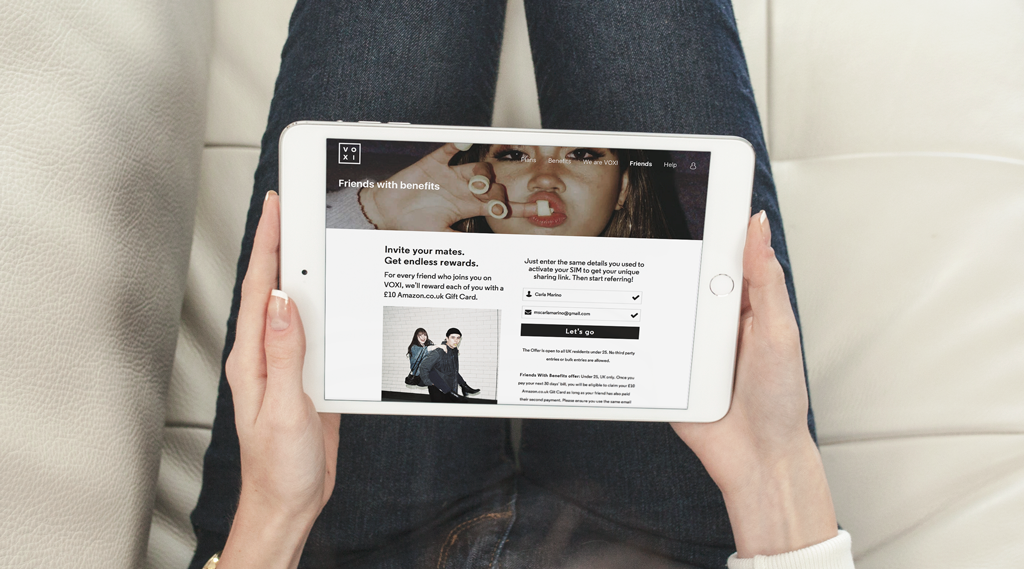
We recently helped a leading mobile phone network greatly increase conversions by upgrading from an uncustomizable off-deck referral microsite to a fully-embedded, fully-branded platform, living in their own website.
To achieve consistency and trustworthiness, you need to make sure that the following elements comply with your branding:
- Colors
- Fonts
- Imagery
- Copy / tone of voice
Hear from Ollie Moore, AVP, Product & Member Marketing at Delta Community Credit Union as to how to use booster campaigns or their ‘double bonus’ to increase customer acquisition.
Boosters vs Evergreen Referral Programs | Delta Community Credit Union
Ollie Moore: "So our program we call it Evergreen. It's one of our bigger contributors toward new customer acquisitions."
"The existing customer and their new referred family or friend will both receive a cash bonus. We often double it up for the member, the existing member, and sometimes for the referred friend a couple of times a year. We call that our 'double bonus' and we do them at key points of the year for members."
"We do it around the holidays when we think that members could use a little extra amount of cash, to maybe take advantage of shopping. We also do it in the summer, so some of the marketing images will evoke that summer feeling of happiness. Sunshine, folks out and about in the community doing things, in the park, going to festivals and things like that."
See Full Video
Refresh Your Program
Many referral programs run out of steam because, once the brand has reached out to their customers and generated an initial run of referrals, they fail to maintain the momentum.
So instead of constantly hitting your existing customers with the same message, you need to spice things up with special events, promotions and a series of stretch targets. Over the years, we’ve found the following activities can dramatically improve performance:
Regularly changing your basic rewards and incentives
By regularly changing your basic rewards and incentives, you can keep your program fresh and get more opportunities to reach out to your existing customers without running the risk of overplaying the same old message. Our Referral Codebreakers research found that customers want to be reminded about your program about, on average, once every two months, and the thing they most want to hear about your program is about rewards and any changes to rewards.
“Our program, we call it ‘evergreen’, it’s one of our bigger contributors toward new customer acquisition. The existing customer and their new referred family of friend, will both receive a cash bonus. We often double it up, for the existing member, and sometimes for the referred friend, a couple of times a year. We call that our ‘double bonus’. We do them at key points of the year for members, around the holidays when we think our members could do with a little amount of extra cash.”
Ollie Moore, AVP, Product & Member Marketing – Delta Community Credit Union
Using tiered rewards
You can encourage multiple referrals per participant using tiered rewards. We have found that, whereas static rewards will get you one or two referrals at best, before customers get distracted and move on, small stretch targets, together with tiered rewards which kick in when those targets are met, can motivate customers to make three or more referrals each. For example some of our clients offer double-rewards at five referrals (which can generate anywhere up to a 35% uplift), others offer free products or personal experiences customers can’t get elsewhere.
Running occasional communal referral drives
An occasional communal referral drive – where everyone gets something great once a certain target is hit, can be effective at increasing participation across a wide part of your customer base. It can be a great occasion to hit home with something your customers care about, such as a local charity or cause – for example, “if we get 1,000 new referred in customers this month, we’ll donate US$5,000 to [cause your customers care about]”.
CSR
Particularly where you have an affluent audience that may not be that interested in rewards, whether cash or gift cards, you can align with your brand’s CSR targets by allowing referrers or referred-in friends to donate their rewards to charities, causes or NGOs. As an example, one telecommunications client of Buyapowa’s ran a successful campaign during the cold winter months where, in addition to paying the normal rewards and incentives, it committed to paying $50 to a homeless charity for each referral completed before a target date.
Running occasional booster campaigns
Short term booster campaigns can be used to offer additional rewards if referrals are made within a specified time period. These can work well if tied to a notable event or anniversary and particularly if they are matched with an ATL campaign. These can also create FOMO or the Fear of Missing Out, to encourage action now.
Gamification
By using gamification with super-stretch targets, you can inspire your key influencers to really go the extra mile to find you new customers, for example by running seasonal leaderboard campaigns that offer money can’t buy prizes to top referrers.
You don’t have to do all these things all the time, but they’re invaluable tools to have in your locker, either to tie in with existing promotional activity or simply to light a fire under your referral program at key times.
Test, Measure, Iterate
Peter Drucker famously said that “If you can’t measure it, you can’t improve it.” So unless your referral marketing software delivers the right suite of measurement tools and analytics, you’ll be flying blind, relying on nothing more than guesses and hunches, and probably those of your HIPPO. And even if you get lucky the first time, the moment something changes – your competition launches a program, your product range evolves, your initial launch shifts into business-as-usual mode – you won’t know how to change with it, and you’ll miss out on potential referrals as a consequence.
This means you need to rely on science and implement a constant test and learn culture, where you identify areas for improvement and run tests to determine if they work or not.
These are just some of the tests you could run:
- Entrance rate for existing customers
- Measure
- How many existing customers click through from your seed marketing?
- How many then go on to express an interest in inviting their friends?
- Test:
- Can this be improved by amending the channel, style or content of your seed marketing?
- Can this be improved by amending the rewards on offer, or even the incentives for their friends?
- Does adding in gamification prizes or tiered rewards have a significant effect?
- Measure
- Sharing rate for existing customers
- Measure:
- Of the customers who participate, how many go on to share with friends?
- How many friends do they share with and via which channels?
- Test
- Can these numbers be improved by tailoring your rewards and incentives?
- Are you offering the correct sharing channels and in the best place?
- Does your sharing rate rise if you send participants a ready-made email to forward to friends?
- Measure:
- Attention and participation among friends
- Measure
- Relative to the number of people who share, how many friends click through?
- Do they participate once they arrive, or quickly bounce away from your site?
- Test
- Are there changes you can make to the default sharing messages customers send out?
- Does it help to display their friend’s name prominently on the landing page?
- Can the participation level be improved by amending the incentive on offer?
- Conversion rates among friends
- Measure
- Relative to the number of friends who hit your site, how many shop?
- How many themselves go on to participate in your referral program?
- Test
- Can the participation level be improved by amending the incentive on offer?
- What works better? A coupon code to copy or an instant incentive applied to their basket
- Do more shoppers go on to become referrers if you implement an auto-invite program?
- Measure
- Measure
- Entrance rate for existing customers
But as each referral program is different, there will be different questions to ask and different hypotheses to test and these will evolve throughout the life of the program.

Work with the Experts
Our recent blog post sets out six key reasons why you should outsource your referral marketing technology to a best-in-class provider like Buyapowa.
This is so you can get the key features we identified earlier in this blog post as being vital to ensure the success of your program, but also so you can concentrate your scarce development resources on what you do best, namely developing your core products and services to generate benefits for your customers. This is exactly the same reason why you don’t build your own email service provider or review technology, but buy the best-in-class solution from a dedicated email service provider like Emarsys or specialist review service like Bazaarvoice.
It’s not just about the referral marketing software. When you work with a company like Buyapowa, you benefit from all our experience having powered hundreds of referral marketing programs for leading brands and retailers as part of our Saas plus Service offering. This means we know exactly how to drive customer acquisition through referrals in telecommunications, insurance, credit cards and banking, energy, gaming and retail. And we have worked in 27 countries and in 21 languages.
So, as part of our managed service, we will advise you as to rewards and incentives, messaging and marketing campaigns, and help you understand and benchmark your performance and review your UX and copy, and identify friction points in your funnel. In other words, advice that can fasttrack your program to success and means you won’t have to guess all the answers yourself.
Hopefully you have found our best practice useful. If you are thinking about starting a program or just looking to improve the performance of your existing program, we would be happy to chat. Just drop us a line and we will get in touch and share what we have learned over the years.