

We’ve long advocated that brands should look to customer referrals as a more cost effective and ethical form of marketing rather than just pouring more and more cash into the pockets of Alphabet, Meta, Amazon, Twitter, Tik Tok and the other search and social media giants. As part of Word of Mouth Marketing, customer referrals are how you can turn positive word of mouth and investments in brand marketing into an actual customer acquisition channel.
And when you consider that our recent Reward Revolution Research found that 95% of people have referred a friend in the past year and an amazing 83% have done so more than once, with 76% of people reporting having received at least one referral invitation in the past year, and 46% of people report having received between two and five referral invitations, the power of referral marketing is evident. So naturally, understanding how to generate referrals effectively is vital to unlocking this modern consumer.
We’ve already set out the business case for referral marketing and reviewed the characteristics of some of the most successful referral programs in previous blogs, but here we’re focusing on how you can generate more customer referrals and the tips and tricks you can use to make referral a sustainable part of your business engine.
Below we’ve set out a list of 30 creative ways to get referrals for your business including:
- Make sure you have a great product or service
- Have a referral program
- Market your referral program
- Keep your referral program on brand
- Ask your customers to refer you
- Ask at moments when your customers have had a good experience with your brand
- Ask and ask again…and again
- Ask your most engaged customers to refer you
- Arm your referrers with convincing arguments
- Sell your product or service on the landing page for the referred-in friend
- Offer great incentives and rewards
- Be as generous as you can afford to be
- Can you offer money can’t buy unique rewards?
- Use stretch targets to drive more referrals
- Pay out more for higher value referrals
- Maximize the perceived value of your referral rewards
- Design rewards to engage your top 1% of referrers
- Payout rewards as fast as you can
- Make it easy and safe to refer
- Reduce the reputational risk for referrals
- Make it easy for the referred-in friend to transact
- Create a friend registration page
- Remind friends that have been referred but not converted
- Freshen it up
- Encourage repeat referrals
- Reach out to Brand Advocates
- Reach out to customers who were themselves referred to you
- Train your staff to ask for referrals
- Recognize referrals if the referred-in friend forgot to use the referral link or code
- Consider opening up your referral program to the public
But before that, let’s go through some basics.
What is a customer referral?
In simple terms, a customer referral is when a current or past customer tells a friend, family member or colleague about your product and service and recommends to that person that they should buy it or try it.
It differs from brand advocacy, brand affinity or being a brand fan, in that the main goal for a customer referral is to encourage an action, typically a purchase, by the recipient of the recommendation. Whereas a brand advocate or fan may simply be willing to increase or amplify your marketing message by wearing your logo, repeating your message, linking to your blogs, liking your social posts etc. Of course, that can and should help your sales, but the primary motivation for a brand fan or advocate is to associate him or herself with your brand.
Nevertheless customer referrals can sometimes be called advocate or ambassador marketing or member get member, while the referral programs operated by brands are themselves often called refer-a-friend, tell-a-friend or invite-a-friend.
And finally, while here we are talking about customers, B2B businesses can also use referral to get new clients with many of the same tactics.
Do customer referral programs need to offer referral rewards?
Word of mouth is a natural phenomenon, which is older than marketing itself and is simply part of the natural social instinct to share advice and news with friends and family, such as where to get a great deal on a new shirt or even which restaurant to avoid. It happens naturally and it’s impossible for any brand to stop.
However, referral marketing is how you take natural positive word of mouth and amplify it by identifying your happy customers and giving them an easy way to share an offer with their social circle. And one way to amplify that is by offering a reward to your customers for each successful customer referral that they make. In other words, it’s an incentive to refer as well as a means to reward or recognise the effort of referring from a loyal customer. Our recent Reward Revolution research found that the majority of respondents reported that an unappetizing reward had caused them not to refer a friend. And an amazing 74% of people said that they would be less likely to refer a friend if there were no reward.
So while it’s not strictly necessary in every case to offer a reward to a referrer, it’s common to do so and our experience suggests that the availability of a referral reward does increase how much you generate referrals, particularly when your offer is not a passion product like telecommunications, insurance, banking or energy. Passion products are subjects that your customers talk freely about with their friends and family such as music, fashion, film, beauty, holidays and interior design, but of course, a referral reward can also increase referrals for these types of business by motivating more discussion and recommendations.
Do you need to offer a referral incentive for the friend?
Although again not strictly necessary, a customer referral is often coupled with an introductory offer for the person to whom the product or service is being recommended. This acts to reinforce the recommendation, especially when that offer is attractive, not freely available elsewhere and only available for a limited time. The key reasons for the incentive is to encourage the referred-in person to take action and take action now.
Our recent Reward Revolution research also found that the majority of respondents surveyed said that they had decided not to act on a referral due to the absence of an incentive or due to an unappealing incentive.
Offering an incentive for the referred-in friend also has the added advantage that if the friend uses the code or link of the referrer then you can accurately track the referral. Without this, the referred-in friend may just buy online or in-store and you have no idea where the customer came from.
If you’re interested in learning more we’ve written in depth about the role of incentives and referral rewards
How can you get more customers to refer their friends to shop with your business?
Here are 19 of the best tips and tricks we can share for increasing referrals:
1. Make sure you have a great product or service
This might seem obvious, but it often seems to be overlooked in practice. Referral marketing is all about getting happy customers to recommend your product or service to their friends and family. So step one is to make sure you have happy customers. And the best way to do that is to make sure you offer an excellent product or service.
Hear from Michael Goodbody, former VP, Head of Marketing & Comms at Robinhood, as to why it’s important to have a product or service your customers want to talk about:
Why you need a great product | Robinhood
"The way that you think about referrals, for the most part, if you want it to be affordable and economical, and a good part of your marketing mix, is you have to have an incredible product that people want to talk about. And then you're just giving them a little bit more of an incentive to tell their friends and family about it.
Actually before I joined Wise, I used to use Wise. I lived in Hong Kong and was moving backwards and forwards between Hong Kong and Switzerland, I used it a lot and I would tell people about it
Because it was a really useful product that I was using. It's a way of being like "Hey I like this product, I want to tell my friends, there's a bunch of people I know that that could benefit from the product, and if I do it now I'll benefit."
At the end of the day referrals only work [if you're] making sure that you understand that your product, in and of itself, is something that people want to recommend.
I think that's a really important part of it because if you don't have that, the cost of getting somebody to make the recommendation goes exponentially higher.
It just becomes a financial transaction."
The first steps should be to audit your customer satisfaction with surveys, NPS surveys, focus groups, store visits, by gathering ratings and reviews and analyzing customer comments in social media. Once you have an accurate picture of your customer sentiment, you can judge how well you’re positioned to benefit from customer referrals. But if you find that there are things you can fix that would improve customer satisfaction, it would make sense to work on that to increase your potential pool of brand advocates or brand ambassadors before launching a referral program.
“You have to have an incredible product that people want to talk about. And then you’re just giving them a little bit more of an incentive to tell their friends and family about it….because if you don’t have that…the cost of getting somebody to make the recommendation goes exponentially higher. [And] it just becomes a financial transaction.
Michael Goodbody, former VP, Head of Marketing & Comms – Robinhood
2. Have a referral program
While you’ll undoubtedly get some referrals from positive word of mouth without a referral program, you may not be able to track them accurately and may be misassigning them to another difficult to track source like television or banner ads (and then compounding the problem by investing more in those channels based on false signals). But by having a referral program, not only can you track and understand where your referrals are coming from but, with the right technology and psychology, you can supercharge the number of referrals you can get and make it a major contributor to your business growth.
Importantly, our recent Referral Codebreakers research found that eight out of ten people expected to be able to refer their favorite brands and almost two thirds of all respondents said they’d view a brand positively or slightly positively if they knew it had a referral program.
In general, we’d say you’d be better off having some kind of referral program than none (that is as long as you correctly manage customer expectations and pay out rewards as and when promised – obviously if you don’t you may actually generate negative feedback from customers who feel cheated when rewards don’t arrive), although the success of a referral program is much more than just choosing the right software. And, where the rest of the elements are in place, such as the referability of the product or service, the promotion of the program, the rewards and incentives etc., we’ve even seen some really basic referral programs deliver good results. Although that’s not to say that they couldn’t deliver better results with expert advice and better software.
Whether you decide to build your own or buy software off-the-shelf, start with a fully fledged program or a basic proof of concept, getting some experience with referrals should allow you to see the potential or understand the challenges of running a successful program. You’ll also want to understand whether you need an enterprise level platform or just need a more basic simple entry level software, at least to start with. We run through some of the considerations in this article.
3. Market your referral program
The most common reason referral programs fail is due to a lack of marketing. Ironic when you consider that they’re typically launched by marketing departments!
But quite simply, if you don’t market your referral program and make your customers aware you have one, and then make it easy to find when they look for it, then you may as well not have one. Our Referral Codebreaker research found that most respondents prefer to be told you have a referral program than have to find it themselves, and the average respondent wanted to be reminded about it once every two months.
So you need to market the program before and at its launch, and consistently throughout the life of the program. And you should be marketing the existence of the program across all customer touchpoints including:
- With prominent fixed positioning on your main website pages: home page headers and footers (ideally site wide), side navigation panels, banners, floating CTAs etc.;
- With mentions in FAQs, customer help pages and prominent tabs in client account areas and apps;
- Regular marketing including dedicated emails, newsletters (including in navigation and footer links), text messages and in app messages;
- As part of interaction with customer support via telephone, chat and chatbots, with messages such as ‘Are you happy with your interaction today? Are you aware that you can earn up to $500 a year referring friends and family to our brand?’;
- At the end of surveys and questionnaires, ratings and review submission messages, statements and in thank you messages after purchase or delivery confirmation; and
- In-store or in-the-field marketing where your employees have direct contact with your customers.
The more you push your program, the more referrals you’ll get. As highlighted in Referral Codebreakers, even the least effective marketing channel, pop-ups or floating CTAs, increase the likelihood of referrals by at least 180%. In other words, the more channels you promote your program across, the more successful it will be.
Hear why you actually need to ask your customers to refer you – Buyapowa’s Referral Experts:
Referral marketing: 3 reasons why a brand needs a referral program
Gideon Lask "All right gentlemen, I want to hear from you two experts, three reasons why a brand needs
a referral program?"
Robin Bresnark: The whole truth? A lot of marketing channels don't work anymore. They're really expensive. It costs a fortune to advertise on Google Facebook or something like that these days. People are blind to it."
Gideon Lask: "Right so traditional marketing is broke."
Peter Cunningham: "The other thing is a lot of people love you as a brand, but their default behavior is to do nothing. Just sit and watch Netflix or to buy from you again. If you don't ask them to refer they probably won't."
Gideon Lask: "All right so you need to activate them."
Robin Bresnark: "Your customers expect you to have one these days. What is it like 90% of customers expect their favorite brands to have a referral program?
Gideon Lask: "And so if you don't have one, I guess that looks kind of weird."
Robin Bresnark:"Yeah.They'll go to your competition and refer them instead."
Gideon Lask: "I asked for three reasons, I got three great reasons. Thanks guys!"
4. Keep your referral program on brand
If a referral program is about anything, it’s all about trust. Trust between you, the brand, and your customer. And between your customer and his or her friend. That’s why it’s super important that your referral program is on brand and is on your website. It shouldn’t be on a supplier’s website and/or have supplier’s branding all over your program, because this will break the bonds of trust. Your customers, or their friends, may think that they’re in the wrong place and leave, or worse think that this is phishing. In his seminal work ‘Don’t make me think‘, Steve Krug explained that every time you make a potential customer stop and think, that’s a moment when you can lose that customer. That’s why you must keep your program on-brand and don’t let your supplier get free advertising on your behalf,
Hear from Katie Brooks, Product Owner at toob, why your referral program should be on brand and on your website:
Katie Brooks: "We know our customers and we know that they want things to be easy to find and accessible.
Which is why we put our refer friend scheme where we did on our website.
And also we not only wanted them to get to the page, but to stay on it.
And we did our research on how other people did their refer a friend schemes and it would [often] send you off to an external page or suddenly all the branding would look completely different.
And what we loved, was where we could put your embed on our page on our site. So people felt like they were still with toob and on toob's page and they didn't have to leave or go anywhere.
They're always on our website, a familiar place that they trust. So yeah, not only getting them to the site, but keeping them there because, like you say, people only have limited time. So if they don't think they're in the right place or they don't recognize it, they'll just click off.
Whereas our campaign, we can really make it feel like us, which is what people were on our site for in the first place."
See the full video here.
“We put our refer friend scheme where we did on our website. We also not only wanted [our subscribers] to get to the page, but to stay on it. And we did our research on how other people did their refer a friend schemes and it would [often] send you off to an external page or suddenly all the branding would look completely different. And what we loved, was where we could put your embed on our page on our site. So people felt like they were still with toob and on toob’s page and they didn’t have to leave or go anywhere. They’re always on our website, a familiar place that they trust. [because] if they don’t think they’re in the right place or they don’t recognize it, they’ll just click off.”
Katie Brooks, Product Owner – toob
5. Ask your customers to refer you
This may be the simplest piece of advice in this whole blog article, but as well as marketing the availability of your program, you need to actually ask your customers to refer you. Many of your happy customers just show their satisfaction by repeatedly buying your product or service, others give you great reviews online, respond with nines and tens in NPS surveys, like your social posts etc. but never think of referring you to friends and family. Unless of course you ask them to do so. Like any good marketing you need a call to action or CTA!
And the importance of this is underlined by our recent The Referral Myth Debunked research that showed that less than half of respondents knew of a brand before it was referred to them.
But asking your customers will be even more effective if you ask them at the right time, when they are in the right frame of mind and have the time to refer your brand. But actually, as summarized by Len Markidan, former Head of Marketing at GrooveHQ, asking at the wrong time can even have negative consequences as “you’ll be ignored (at best), or you’ll put them off (at worst).”
“[For] a lot of people… their default behavior is to do nothing,…just to buy from you again [and again]. If you don’t ask them to refer, they probably won’t.”
Peter Cunningham, Director of Marketing – Buyapowa
We wrote a whole blog about the right time to ask for a referral, but to summarize, you’ll have a lot more chances of getting customer referrals if you ask them at the exact moments when they’re feeling the most satisfied with your brand. Happily there are many moments when customers signal that they are happy with your brand such as:
- Following your brand and liking your posts on social media, and even defending your brand in online forums and threads;
- Giving positive feedback in online reviews;
- Giving positive feedback in customer surveys and high NPS (Net Promoter Scores);
- Reporting satisfaction in-store, to call centre agents or in website exit pop-ups (e.g. “How happy were you with your experience today?”);
- Purchasing your product or service, particularly repeat purchases;
- Upgrading your service (e.g. subscribing for Amazon Prime, upgrading to a premium membership, taking out a new line, adding new services, etc.);
- Reaching a milestone (e.g. having been a subscriber for a year, used a service a certain amount, etc.);
In particular, just after a purchase or just after receiving your product is a great time to ask for a referral, as the initial dopamine high from the purchase or the thrill from first getting your hands on the product means you’ll be happy to tell others, as seen from the countess unboxing videos on YouTube. So a floating CTA after purchase or a message on the product purchase confirmation page or email can be a great way to market your referral program.
And remind your customers that they can still refer, especially if they started the process but didn’t actually refer or if they referred but their friends didn’t accept. You might just be surprised how effective a little nudge can be.
Hear from Jacob Tice, Senior Marketing Specialist at Trupanion on how they encourage customers to refer after they’ve had a really strong experience with the brand
Robin Bresnark: "In terms of activating people, when do you tend to do that? Do you do that when people first come along or after they've received treatment? When do you find people are more likely to refer and when would you sort of encourage them to do that?"
Jacob Tice: "We encourage them to refer after they've had a really strong experience with us for one, and after that initial enrollment period. That first hospital visit is when we really want to see them enroll so that they can get the absolute most out of their coverage. And so for us, when we're talking about referrals that means as a part of their enrollment process of getting oriented and familiar with Trupanion, with our coverage with our policies.
Those are the moments where we're like 'hey if we know that this is something that you're going to love and use, then you should bring your family, bring your loved ones, bring your friends in along with you because they'll love it too.
And I would say identifying specific moments in the journey where that is going to be the most compelling ask is an important part of building your referral program.
After a successful claim, after someone has gone through the Trupanion experience, they've had their vet paid directly upfront, no waiting for reimbursement, their pet is feeling better. They're feeling good about their interaction with us, with their veterinarian. Again, we have that opportunity to put that forward and say therefore, you know, refer your friends."
See the full interview here.
6. Ask at moments when your customers have had a good experience with your brand
If you can identify moments when your customers are likely to be very satisfied with your brand or service, then this is the perfect opportunity to ask them to refer you. For example, this could be when a customer first purchases or signs up and is feeling happy about having made a great new discovery to solve a problem that he or she knows a lot of friends also have. It could be when they renew, upgrade or convert from a free to premium service or after the successful resolution of a client support ticket. For example, in the context of a health insurance or pet insurance policy, this can be just after signing up, as the policyholder may feel that he or she has done something positive for their family or favorite furry friend, or after a success claim when healthcare or veterinary costs are paid. So, if you can identify those moments and reach out asking for a referral when your customers feel good about you, you’ll be likely to get more referrals.
“We encourage them to refer after they’ve had a really strong experience with us…as a part of their enrolment process of getting oriented and familiar with Trupanion, with our coverage with our policies….And I would say identifying specific moments in the journey where that is going to be the most compelling ask is an important part of building your referral program….After a successful claim, after someone has gone through the Trupanion experience, they’ve had their vet paid directly upfront, no waiting for reimbursement, their pet is feeling better. They’re feeling good about their interaction with us, with their veterinarian. Again, we have that opportunity to put that forward and say therefore, you know, refer your friends.”
acob Tice, Senior Marketing Specialist – Trupanion
Hear from Buyapowa’s Director of Brand, how mere increased exposure to something tends to increase our positive feelings towards it:
What is Charles Goetzinger's bag experiment?
Robin Bresnark: "Mere exposure theory.
The more we see something the more we like it.
There's two people of note in those pictures. You got the guy in the middle on the left, and the guy with the big giant black bag over his head and body.
Here's how the experiment went:
One day, this guy known only as 'the Bag' turns up and goes in this class. And the reaction from the other students is not kind:
'Who's the bag?'
'What the hell does he think he's doing?'
It's weird and they're kind of freaked out.
Now the months go by, months and this goes on for months and the mystery student keeps coming to class shrouded in his bag. Turns out contrary to popular belief, familiarity doesn't breed contempt at all, and nor does absence make the heart grow fonder. But gradually his peers reactions turn from hostility to curiosity and eventually to friendship.
That's why repeating a message again and again through more and more channels can work wonders when it comes to marketing. Keep repeating the invitation and even the coldest customers begin to thaw."
7. Ask and ask again….and again
It’s important not just to ask your customers to refer you once, but you should ask again and again and again. This is grounded in the psychological theory called the mere exposure effect, as popularized by Charles Goetzinger’s bag experiment. It shows that people are more likely to like something the more they are exposed to it. And when it comes to referrals, your customers are more likely to refer you, the more you ask them to. It stands to reason because the first time you ask, they may be too busy doing other things or may intend to refer you but just forget, or maybe they feel they’d like to spend a just little more time with you before recommending you. And, according to the theory, the more you ask them to refer you, the more they’ll like the idea.
“Mere exposure theory. The more we see something the more we like it….That’s why repeating a message again and again through more and more channels can work wonders when it comes to marketing. Keep repeating the invitation and even the coldest customers begin to thaw”
Robin Bresnark, Director of Brand – Buyapowa
Hear from David Hixon, Executive Director – Head of Product & Lifecycle Marketing at Ally Bank on why your most engaged customers tend to refer other highly engaged customers:
Engaged Customers Refer More Engaged Customers? | Ally
David Hixon: "We need a certain behavior to make that value exchange worth it.
You can't just open an account. You need to be active and engaged. And that that term engagement is a big deal for us.
Our ideal customer is somebody who's very engaged with us. And by that I mean, if I walk up to a person on the street and I say, "Hey, who do you bank with?" And they say, "Ally Bank", I like that.
I like that person because that means they're likely using us to pay their bills. They're likely using us with getting their direct deposit from their employer and all the things that make you a primary bank.
And what we're learning is that, to your point, the people that are more engaged are the people that are more likely to refer. And then the people that are coming in through those referrals are also then more likely to engage.
So it's this circle of life. The people that we like are the ones that are going to refer. And they're just going to refer more people that we like.
We've done a lot of math to compare it against the distribution of new customers that come in BAU, how many of them go on to become engaged and a valuable customer to us. Those numbers are much higher for the customers that come in through referral than those that come in through the BAU channels."
See the full video here.
8. Ask your most engaged customers to refer
If you can identify your most engaged customers, those who use your product or service the most and/or generate the most money for you, then you should ask them to refer you. This is because they will often refer you other engaged and high value customers. You can do that by offering access to a VIP referral program or offering them additional rewards in your main program.
“What we’re learning is that the people that are more engaged are the people that are more likely to refer. And then the people that are coming in through those referrals are also then more likely to engage. So it’s this circle of life. The people that we like are the ones that are going to refer. And they’re just going to refer more people that we like.”
David Hixon, Executive Director – Head of Product & Lifecycle Marketing at Ally Bank
Hear from Katie Brooks, Product Owner at toob, why you should reaffirm your USPs on the referrer page to provide arguments for your referrers to help convince their friends:
Robin Bresnark: "So many USPs on the referrer page and I love this. So the page the friend lands on. Yeah, of course unique selling points. That is a sales page. Right. But so is the referrer dashboard.
What you find is a lot of people go, I don't really know how to explain to my cousin why they should change.
Give them five reasons. They can pick the three that really resonate and focus on those."
Katie Brooks: "toob is very customer focused. So we wanted to build that page, like you say, as a tool for our referrers to go and talk about it to their friends. Because you could say, 'Oh, toob is great.' And when someone says, 'Why?' You can't always put your finger on it. So, we've given them the tools that they need to facilitate those conversations and be our best ambassadors."
Robin Bresnark: "And also it's a case of reminding them that if you tell your friends about this, your friends aren't going to be annoyed with you.
You're saying nice things that maybe they didn't even know themselves. 'Oh wow, there are toob are available in all these places now'."
Katie Brooks: "The scheme is built for our referrers and our friends. We want them to have the benefit. So absolutely, giving them that information so they can make genuine referrals is the way that we want to do it."
See the full interview here.
9. Arm your referrers with convincing arguments
Your potential ambassadors may not always have the right arguments at hand to convince their friends to sign up or purchase your product or service. So the referrer page or referrer dashboard is a great place to summarize the unique selling points of your product or brand, so that your referrers know what to tell their friends. Simply setting out a few bullets here can help increase referrals.
“So we wanted to build the page as a tool for our referrers to go and talk about it to their friends. Because you could say, ‘Oh, toob is great.’ And when someone says, ‘Why?’ You can’t always put your finger on it. So, we’ve given them the tools that they need to facilitate those conversations and be our best ambassadors…So absolutely, giving them that information so they can make genuine referrals is the way that we want to do it.”
Katie Brooks, Product Owner – toob
Hear from Katie Brooks, Product Owner at toob, why your the landing page for the referred-in friend should balance information about the referral process with the key reasons why you should want to buy from the brand:
Robin Bresnark: "The page the friend lands on. Of course. Unique selling points. That is a sales page.
And you do all these really interesting USPs.
So, you talk about how many customers you already have. It's hugely important because that's social proof.
You want to know that there are hundreds of thousands of other people in the country who are very happy doing it. That's really, really important. Most brands, they work really hard on their homepage. Because it's super important. But that friend landing page has got to do the same job that your homepage does."
Katie Brooks: "We wanted it to be a balance between the kind of the information to do with the refer a friend scheme and the process that they were about to enter into, and also the kind of the reasons why that they should be buying with toob.
So we used a lot of your guidance and support when we were doing the integration on what these pages should look like, what information they should contain, and how to get that balance right. So, the friend didn't feel bombarded by sales information and completely pulled out of the fact that it was a referral process. But also making sure that all the key information that we feel customers need in order to make the decision to buy with us was there. And easily accessible and clear."
See the full interview here.
10. Sell your product or service on the landing page for the referred-in friend
When a person clicks through from a referral link, the landing page that they see should sell the merits of your product and service, as well as reminding them that they have been referred and that they will get an incentive if they complete the referral. This is a sales page. It may be the first page that person has ever seen from your brand, so sell yourself and list USPs.
“We wanted [the landing page] to be a balance between the kind of the information to do with the refer a friend scheme and the process that they were about to enter into, and also the kind of the reasons why that they should be buying with toob… So, the friend didn’t feel bombarded by sales information and completely pulled out of the fact that it was a referral process. But also making sure that all the key information that we feel customers need in order to make the decision to buy with us was there. And easily accessible and clear.”
Katie Brooks, Product Owner – toob
Why you shouldn’t forget the importance of friend incentives in your referral program – Buyapowa’s Referral Experts:
Referral marketing: Do friends need incentives?
Gideon Lask "All right, Peter, Robin, a very serious question okay? Does the friend always need to be incentivized. As a referrer, do I always have to say 'Peter you're gonna get something', 'Robin you're going to get something'?"
Robin Bresnark: "No, but it needs to at least be best in market. So if ordinarily, to a new customer, you're offering £10 off your first shop, you've really got to at least offer that, otherwise it's going to make the referrer look like a bit of a mug. 'Gids why don't you go to such and such shop and buy something. You go there and go 'oh well my friend sent me and I'm not getting this offer that I would have got if no-one sent me'. That's awful, so never do that. But doesn't need to be more than that, that's very much dependant on what brand or the product is."
Gideon Lask: "All right, any thoughts Pete?"
Peter Cunningham: I would say don't underestimate the importance of an incentive for the friend. Some research
Harvard did last year, a year or two ago, [where] they did some research and they offered people the choice between keeping all the reward, sharing the reward, giving all the reward or giving it to charity, and you know what? Actually most people gave it to their friend. So there is something nice about saying to your friend 'I'm recommending this product or service to you and I'm giving you a great deal."
Robin Bresnark: "Interestingly, I'll just jump in gender comes into play there as well, right. Because men and women refer very differently. So men generally they want to get something themselves, women generally want something for their friends. It's amazing, you would have believed it? So there's all kinds of things to think of. So you need to think what is your brand, what are you selling, what do you want people to think of you and then you need to tailor it."
Gideon Lask: "Brilliant, thanks guys."
11. Offer great incentives and rewards
As mentioned above, rewards and incentives can play a key role in the success of a referral program. Without a reward, you’re simply relying on the goodwill of your customers and their ability to find time in their busy daily lives to refer your business instead of the myriad other things they could do with their time. Recent research from Yale and UC Berkeley found that referral rewards can also help overcome the psychological reluctance to refer due to the risks that a referral might turn out to be bad and negatively affect the reputation of the referrer, and potentially the friendship if the purchase is an important one!
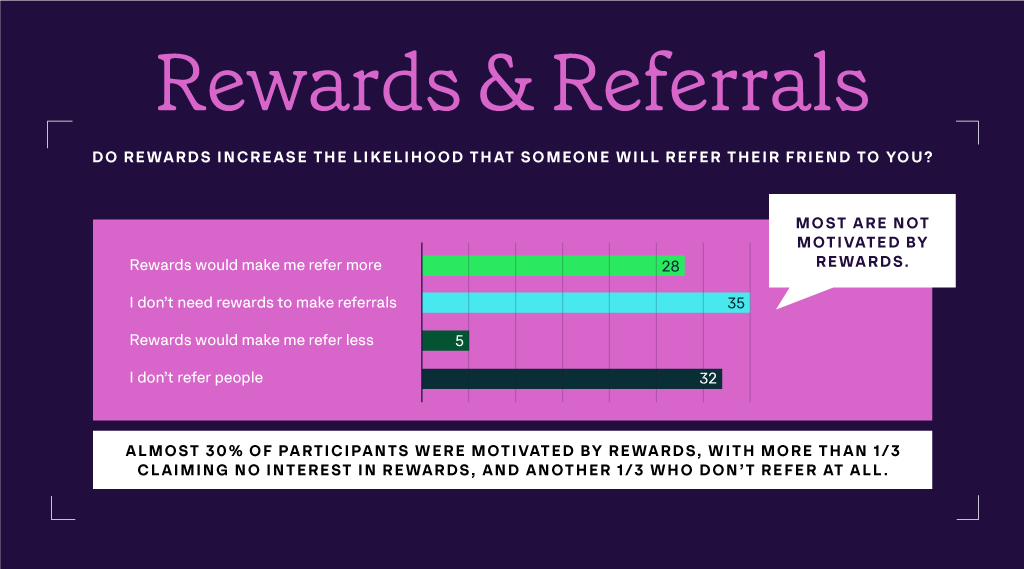
But you shouldn’t just be offering any old reward. To encourage action and action now, you need to offer something that is really compelling for your audience. That means doing a little research into your customer base and understanding what would appeal to them. Of course, a good start could be to survey your customer base to find out what would be most likely to motivate them to refer, but rather than trying to offer a ‘one size fits all’ reward, a better option is to offer Rewards Choices where your customers can choose whether they would prefer cash, a voucher or gift card, or even to give the equivalent amount of money to charity on their behalf. As highlighted in our Reward Revolution research, most respondents expected to be offered a choice of between 3 and 4 rewards.
“Research Harvard did a year or two ago, [found] where they offered people the choice between keeping all the reward, sharing the reward, giving all the reward or giving it to charity, [that] most people gave it to their friend. So there is something nice about saying to your friend ‘I’m recommending this product or service to you and I’m giving you a great deal’”
Peter Cunningham, Marketing Director – Buyapowa
You should also think of the context of the reward you’re offering, including in terms of the effort you’re asking of the customer, the value of the newly referred-in customer to you, what you’d pay for a customer through any other channel and, importantly, what the competition is offering. Although the purpose of the reward is to thank your customers for their efforts, and shouldn’t be so generous to encourage unwanted behavior, such as referring people they don’t know for a product they don’t use (which is more akin to affiliate marketing than referral), the offerings of your competitors do set a benchmark for what people think a referral’s worth and what’s a fair compensation for their efforts. We explore the idea of how much you should reward in more detail below.
You should also think about changing your rewards from time to time, including introducing a bit of jeopardy so that people only have a short window of opportunity to act, as Revolut does so well, as we explain here with offers that expire after a fixed date. You can also offer tiered rewards that increase in value or offer additional bonuses when milestones are achieved, such as 5 confirmed referrals or 3 more referrals before the end of the month.
And you should not forget the impact of a good friend incentive in motivating a referrer to share. Research from Harvard Business School, Olin Business School and the University of California found that, in a research project where referrers were offered referrers to choose between keeping all the referral rewards, sharing them, giving all to the friend or donating to a charity, the majority chose to give all the reward to the friend. This is because the motivation to refer is often, not only to give your friend a good recommendation but also give them a good deal.
Hear from Asya Kuznetsova, Product & Growth at Wise as to how to choose powerful rewards for your referral program.
Which Referral Rewards Should You Offer | Wise
Asya Kuznetsova: "So I guess the most important bit, and this is a very product perspective, you need to understand your customer segments, and you need to actually go and talk with them and just [ask]: [why] do you recommend my product, for what action?"
"You need to very clear understand why they're recommending your product and for what, and what could be the right incentive for them. For most people, cash would be a good incentive. But of course if we look at more upscale segments and premium products, cash is no longer motivation there. Early access to features or some premium services could be."
"There is a category of users, that is hardest to identify, who are not interested in any rewards they just want to share the love for the product, and they want to give benefits to others. And for this category, using cash or any other incentive would not work."
See Full Video
12. Be as generous as you can
As well as deciding what type of reward you should give, whether cash, gift cards, vouchers, loyalty points, free months or upgrades or product etc., you should also decide how much those rewards should be worth. Should you give a US$25, US$50 or US$100 in cash or vouchers etc?
To decide this you need to first know what your average customer lifetime value is (CLTV). In other words, the average purchase value from your customers multiplied by the total number of purchases your typical customer will make with you over an average customer lifespan. If your business is new and you don’t have enough detailed customer data to calculate this, you can look for public benchmarks from comparable businesses.
Clearly you shouldn’t be paying out rewards and incentives that are higher than your expected CLTV. Unless you’re blitzscaling bankrolled by aggressive Venture Capital money, and even that can’t continue forever, it would be a surefire route to bankruptcy. But remember that you can’t pay out all of your CLTV in rewards. You need to factor in your costs of serving your customers, your fixed costs and meeting the requirement to earn more than your cost of capital for your investors.
Another key statistic is your average cost of customer acquisition (CAC), or more realistically the costs you would pay to acquire the same customer from other channels such as paid search, affiliates, banner marketing, search engine optimization and above-the-line marketing. Because, if you can get the same customer more cheaply elsewhere, then you should probably prefer that other marketing channel. Happily, research shows that referred-in customers typically cost much less to acquire than from other channels. So you can look at the cost of alternative channels as being a proxy for the maximum you can afford to pay.
Of course if you’re in an industry with high CLTVs such as telecommunications, banking, insurance and gaming, it’s likely that your competitors will also be bidding high for new customers through other channels and offering generous referral rewards.
A good rule of thumb is to think of between half and two-thirds of your CLTV as the maximum you can afford to pay out.
“You need actually go and talk with [your customers] and…very clearly understand why they’re recommending [you] and what could be a right incentive for them. For most of the people, cash would be good, but [for] more upscale segments and premium products, cash is not a motivation. Early access to features or some premium services could be.”
Asya Kuznetsova, Product & Growth – Wise
Hear from Michael Goodbody, Former VP, Head of Marketing & Comms at Robinhood, how one of a kind, exclusive fan based rewards can drive referrals:
The power of one-of-a-kind rewards | Robinhood
Michael Goodbody: "We had a credit card that we launched. It was a what we call the Robinhood Gold Card.
It's a stainless steel kind of gold color card.
If we produce a pure gold variant of the card it has this implied value that people can't quite help themselves with.
So we ended up offering if you got, I think it was 10 people referred onto our gold product, there's a subscription product that you need before you can take the gold card, [then] you would get a pure gold karat gold version of the card.
And so I think that was a really interesting way of thinking about how do you get people not just to think about this as monetary value but beyond that.
You certainly saw people crusading out there, desperately trying to get all of their friends and family to sign up because they just this was the only way to get this pure gold credit card and they just really wanted it
And I think that was something that we saw work really well as well."
13. Can you offer money can’t buy unique rewards?
Often the best rewards are not based on monetary value, but are money can’t buy, prestige or experiential rewards that appeal to brand fans. We’ve documented how Tesla has engaged its fan base offering referral rewards that appeal to its loyal fans offering everything from factory tours, early access to new products, or exclusive products such as the Cyber Hammer. In a similar vein, Michael Goodbody, formerly of Robinhood, explains how the brand drove a huge number of successful referrals by offering a pure gold version of their credit card. So in structuring your rewards, you should always consider what exclusive fan based rewards you can offer.
“[We produced] a pure gold variant of the card [and it had] this implied value that people can’t quite help themselves with. You certainly saw people crusading out there, desperately trying to get all of their friends and family to sign up because they just this was the only way to get this pure gold credit card and they just really wanted it. And I think that was something that we saw work really well as well.”
Michael Goodbody, Former VP, Head of Marketing & Comms – Robinhood
Hear from Michael Goodbody, Former VP, Head of Marketing & Comms at Robinhood, how using stretch targets with very generous rewards for reaching a referral milestone can increase the number of referrals you can get without increasing the average cost per referral:
How to Boost Referrals with Stretch Targets | Robinhood
Michael Goodbody: "We had a credit card that we launched, it was a what we call the Robinhood Gold Card. We ended up offering if you got, I think it was 10 people, referred onto our Gold product, then you would get a pure gold like 14 karat gold version of the card.
Anytime on the referral side, you set a cap, at like 10, it's really hard to get.
I don't know about you, I don't think I have 10 friends that I can convince to do anything, like even turn up on time to a to a dinner, so never mind actually getting them to take out a product.
But they'll be like 'hey get seven people and we'll give you US$987.'
People are looking at that US$987 and thinking 'well I can get a massive amount of money.'
But obviously if they refer three people, which is probably more likely the average that they're going to be able to get. If they like try hard it's going to be two three four, then you don't pay out the reward or you don't pay out the accelerated reward.
And, so I think in that scenario you can create this idea of this perceived value of money and on average it might still only cost you five or 10 bucks per referral up to 10 and then $1,000 for the 10th, but the consumer sees it as $1,000 or like a hundred bucks each [referral] and you're actually paying out five.
14. Use stretch targets to drive more referrals
One way to generate more referrals without increasing the cost per acquisition for all of your referrers is to offer a lower value reward up to a treshold, say 10 referrals, and then offer a large reward for reaching that threshold. As explained by Michael Goodbody, Former VP, Head of Marketing & Comms at Robinhood, in the video above, if you offer, say, US1,000 for ten referrals but only US$5 for each referral up to that point, your customers will see the value as being US$100 per referral, when in actual fact, given that few people will likely reach ten referrals, the brand only pays out US$5 for most of the referrals. This is a clever use of the framing concept using stretch targets.
“Anytime on the referral side, you set a cap, at like 10, it’s really hard to get…[a brand can say] ‘hey get seven people and we’ll give you US$987’ [And] people are looking at that US$987 and thinking ‘well I can get a massive amount of money.’…But obviously if they refer three people, which is probably more likely the average that they’re going to be able to get. ….then you don’t pay out the reward or you don’t pay out the accelerated reward….in that scenario you can create this idea of this perceived value of money and on average it might still only cost you five or 10 bucks per referral up to 10 and then $1,000 for the 10th, but the consumer sees it as $1,000 or like a hundred bucks each.”
Michael Goodbody, Former VP, Head of Marketing & Comms – Robinhood
15. Pay out more for higher value referrals
Of course, you should only pay out for confirmed and valid referrals, ideally where the referred-in customer has met post completion requirements such as having paid two insurance premiums, so you don’t pay for worthless referrals that are cancelled within cooling off periods. You should also have basic anti-fraud protections to avoid paying out for self referrals where customers try to refer themselves to get a discount and reward. But also, unless you sell just one product available in one format and quantity, it’s likely that not all referrals will have the same value to you.
Hear from Michael Goodbody, Former VP, Head of Marketing & Comms at Robinhood, on why paying out higher rewards to higher value customers works really well:
High Value Customers Refer More High Value Customers | Robinhood
Michael Goodbody: "What you do see with referrals, if you look into it, is that high value users refer high value users.
It's a network effect, so you really got people driving their networks, and their networks are [often] quality networks.
And so whenever you're thinking about building a referral campaign. Yes, on average you might be requiring users that are worth 20 bucks, and you're gonna pay 10 bucks. But in fact, the $100 users are going to refer $100 users, and the $5 users are going to refer $5 users."
Robin Bresnark: "It's interesting talking about high worth customers. Did you ever consider having different referral programs for different types of customers?"
Michael Goodbody: "Absolutely, it works really well.
If your generic entrance point is $5. When somebody's shown-you that they're a top 5% customer, giving them a 5X reward. You do see they respond better to that."
Ideally your referral program will let you pay out different rewards according to the purchase or subscription from the referred-in friend. For example, a telecommunications brand would want to pay more for a customer who signs up to a multi-year quadruple or quintuple bundle than someone who just takes out a pre-paid SIM Only card option. As well as avoiding overpaying for low value conversions, you can offer more attractive rewards for the customers you really want and drive more high value business. If your referral program doesn’t allow you to do that, then perhaps we should talk?
“On average you might be acquiring users that are worth $20, and you’re going to pay $10. But, in fact, the $100 users are going to refer $100 users, and the $5 users are going to refer $5 users…..works really well….when somebody’s shown you that they’re a top 5% customer, giving them a 5X reward. Youu do see they respond better to that.”
Michael Goodbody, VP, Head of Marketing & Comms – Robinhood
Another way to encourage customer referrals and increase the return on investment from them is where your conversion process involves many steps, such as a free trial or a freemium option, or in B2B referrals where there are many stages and considerable time between the first point of contact and the sale. The trick is to pay small rewards, like a US$5 Starbucks card, for lower value micro conversions like signing up for a free trial but a higher payout when the referred-in friend converts to being a paying customer. Of course, to have the maximum effect, you can emphasize the bigger reward available for the full conversion in your marketing: ‘earn up to $100 when your referred-in friend subscribes to our 5-star plan’ etc.
“And of course, the simplest thing to do is a “give $5, get $5” and give that offer to everyone, in an untargeted fashion. But a product leader soon realizes that this is inefficient — perhaps it’s best to give some users $15 and others $5, depending on their value.”
Andrew Chen, Partner – Andreessen Horowitz
Hear from Michael Goodbody, Former VP, Head of Marketing & Comms at Robinhood on how to increase the perceived value of a referral reward:
Rewards with a high perceived value, but low cost | Robinhood
"How do I take a single dollar and maximize the perceived value of that dollar to the consumer?
One of the most interesting dynamic products that I've seen on that front is....I worked for a company called Credit Karma in the U.S, with about 120 million users in the U.S. or globally. And it's a way of getting your credit score.
And one of the interesting things there was there's a product called Audit Defense which turbo tax sells and Credit Karma offered.
This idea [that], if you ever get audited by the IRS, we'll provide you with an accountant and a lawyer to help you fight that.
And again, I think the cost of that to the companies is somewhere in the region of a dollar or two dollars. Because it's a very unlikely outcome that anyone will ever get audited.
But the perceived value of that to a consumer is 30, 40 or 50 bucks.
I think Acorns do a really good job of this. [They say] get seven people and we'll give you US$987.
From a referral perspective people are looking at that US$987 dollars and thinking 'well, I can get a massive amount of money'.
But obviously, if they refer three people, which is probably more likely the average that they're going to be able to get. If they like, try hard, it's going to be two, three, four.
Then you don't pay out the reward, or you don't pay out the accelerator.
And so I think in that scenario, you can create this [high] perceived value of money. And, [on] average, it might still only cost you five or ten bucks per referral.
I've certainly seen it work in other companies, where you're using that kind of idea of 'how do I take a single dollar and maximize the perceived value of that dollar to the consumer?'
See Full Video
16. Maximize the perceived value of your referral rewards
As explained by Michael Goodbody, Former VP, Head of Marketing & Comms at Robinhood, any way you can take each US$1 of rewards and make it seem like US$10, will increase the attractiveness of your referral program. Ways to do this include, as Robinhood did, by offering a random stock as a referral reward, or by using stretch targets like Robinhood did with its 14 Karat Gold Card and Acorn does by advertising the chance to earn up to US$987 by referring 7 new customers. By increasing the desirability and perceived value of the rewards you offer, you can encourage more referrals, often without increasing the customer acquisition cost (CAC) of your program.
“You can create this [high] perceived value of money. And, [on] average, it might still only cost you five or ten bucks per referral…I’ve certainly seen it work…where you’re using that kind of idea of ‘how do I take a single dollar and maximize the perceived value of that dollar to the consumer?”
Michael Goodbody, Former VP, Head of Marketing & Comms – Robinhood
Hear from Michael Goodbody, Former VP, Head of Marketing at Robinhood, as to why, if you can identify your most valuable referrers, then offering them extra rewards and special treatment can increase referrals and improve retention.”
How to Engage the Top 1% | Robinhood
Michael Goodbody: "What you also find with higher value users is they tend not to react well to the generic offer.
Being willing and able to pay a high value, five or 10 times what you would [normally] pay, is really helpful because it helps engage them.
It also makes them feel better. One of the things that I found is that in that scenario anytime you can tell your customer that they're special to you and you give them something that makes them feel that you care about them a little more, or recognize how much business that they do with you, I think that always helps.
There's retention impacts of offering higher quality users high quality rewards because they just feel appreciated and that's something you should always be looking to do with those types of customers.
If you know somebody is a higher value customer [then] giving them a higher value reward, absolutely [it] like works really well."
17. Design rewards to engage your top 1% of referrers
As well as paying out more for individual referrals which are more valuable to you, you should also consider whether you can identify high value referrers and offer them special treatment, for example offering higher value rewards or special rewards that are not available to others. As mentioned, by Michael Goodbody, Former VP, Head of Marketing at Robinhood, in the video above, these kind of referrers tend not to react well to the generic offer, and any time you can show them that you care about them and recognize the value they drive for you by offering extra rewards, can work really well not just for generating referrals but also in terms of retention.
“Higher value users..tend not to react well to the generic offer. Being willing and able to pay a high value, five or 10 times what you would [normally] pay, is really helpful because it helps engage them. It also makes them feel better. One of the things that I found is that in that scenario anytime you can tell your customer that they’re special to you and you give them something that makes them feel that that you care about them a little more, or recognize how much business that they do with you, I think that always helps….If you know somebody is a higher value customer [then] giving them a higher value reward, absolutely [it] works really well.”
Michael Goodbody, Former VP, Head of Marketing & Comms – Robinhood
Hear from Katie Brooks, Product Owner at toob, why, unless you have a good reason not to, you should pay out rewards as soon as possible after a referral:
Robin Bresnark: "Your cooling off period is 14 days, because that's all the cooling off period needs to be. It's not always the case.
We have plenty of clients where it just has to be longer.
In the case of a business like yours, often a bit of engineering work is done or equipment is sent out. But when you're in you're in right?"
Katie Brooks "We didn't want anyone to have to wait longer than they needed to. And we knew that a scheme that makes you wait 30 days or even perhaps 60 days, just might not have suited a lot of our customers.
We just think that it's a really nice treat, when you've passed that 2 week cooling off period. Hopefully enjoying all the benefits of full fiber and the router that we've sent out to you, that then we reward you for enjoying that two weeks with your voucher."
Robin Bresnark: "And you actually prolonged that magic period at the beginning of a relationship as well, because you're right [that in] those first two weeks, hopefully people are saying my internet is so good. That's a joy for a few days, and then it just becomes part of the furniture and you don't get excited about it. But then you get that little present."
See the full interview here.
18. Payout rewards as fast as you can
Subject to any delays required to make sure that referrals are valid and that any post completion conditions are met, like paying a bill, you should aim to pay out rewards and incentives as fast as possible after confirming the referral. This will increase the feel good factor as your customers get to experience the rewards sooner, and seeing the value will be more likely to refer again. Where there will be a delay, it’s best to manage expectations by making that clear on the face of the referral program and by having a personal account area or dashboard for referrers so they can see the progress of their referrals and understand if and when they’ll get paid out.
“We didn’t want anyone to have to wait longer than they needed to. And we knew that a scheme that makes you wait 30 days or even perhaps 60 days, just might not have suited a lot of our customers. We just think that it’s a really nice treat, when you’ve passed that 2 week cooling off period. Hopefully enjoying all the benefits of full fiber and the router that we’ve sent out to you, that then we reward you for enjoying that two weeks with your voucher.”
Katie Brooks, Product Owner – toob
Hear from Ollie Moore, AVP, Product & Member Marketing at Delta Community Credit Union, as to why you need to keep your referral program simple and easy to use:
Is your referral program simple enough? | Delta Community Credit Union
Ollie Moore: "You want to make sure that your referral program is simple."
"One of the things that we do love about our program is the ease, the simplicity of it. So that our members don't feel like they have to share too much of their information."
"They don't really have to share anything. Just a link to their friends and family."
"Before we partnered with Buyapowa, there were some things that were clunky there. When we did have it where you'd have to have the member's name. Or where the member would go by a nickname in their personal life but for their banking they would go by the formal name."
"You know a unique link that each member can use to bring their family and friends on, works just perfectly and smoothly. And we think it encourages people to use the program even more so."
See the full video here.
19. Make it easy and safe to refer
Don’t put up barriers to customers who want to refer your brand by making them type in the names, emails, phone numbers, address etc. of their friends in your referral program. Not only is it likely to be in breach of privacy laws and regulations as we explained here, the fact that they may not have these details at hand may make them stop and go look for them, and never come back. As Steve Krug wrote in his seminal book Don’t Make Me Think, everytime you make your potential customer stop and think, there’s a risk that he or she changes his or her mind.
In the same vein, you shouldn’t limit the ways your referrers can share, such as requiring them to use email. Instead allow them to use all their favourite apps and sharing tools by enabling native sharing straight from their mobile phones where they can share a personalized link or code in a couple of clicks.
Additionally, as mentioned above, make your referral program visible and easy to find with prominent positioning on your home page and with an easy to remember URL www.yourcompany.com/refer-a-friend.
“You want to make sure that your referral program is simple. One of the things that we do love about our program is that the ease, the simplicity of it, so that our members don’t feel like they have to share too much of their information…we think it encourages people to use the program even more so.”
Ollie Moore, AVP, Product & Member Marketing – Delta Community Credit Union
And finally, there’s nothing more likely to put off a potential referrer than the thought that this isn’t legitimate. That there’s something wrong with the site, maybe it’s phishing, maybe it’s a scam etc. That’s why it’s vital to have a white label referral program, ideally on your own website using your own URL on https with your trust signals like badges, ratings and reviews etc. Conversely it’s a bad idea to have your program on a supplier’s website with the supplier’s logos and branding everywhere as you’ll probably make the potential referrer stop and think. A referral should be between you, the trusted brand, and your happy customer. You shouldn’t let anyone or any supplier get in the way of that and you should definitely make sure your supplier doesn’t take co-ownership of your customer data and use it to market other products.
Buyapowa’s Referral Experts discuss why it’s vital to have your referral program on brand A-Z:
Referral marketing: Worst referral mistakes
Gideon Lask: "I'll let you guys into a secret. We are sadly nerdy about all things referral. And in our spare time we look at hundreds and hundreds of referral programs. I'd love to hear from you guys what you feel are some of the most common mistakes made by people with their referral programs what makes a referrer stop in their tracks or a friend say 'I'm not participating'?
Robin Bresnark: "Number one for me it doesn't look like a core thing the brand is doing. It's an afterthought. The worst case of this is when the program is hosted on a microsite with a different url. Maybe whoever is providing the software has got their brand all over it. Maybe that's the url that the referral might share with their friend. Maybe it's referral platform.com - that's awful."
Gideon Lask: "So it needs to be trustworthy, on-brand, integrated into the experience."
Robin Bresnark:"Yeah if I'm your friend and you want me to shop at this shop don't go telling me about some referral platform. That's horrible."
Gideon Lask: "Got it."
Peter Cunningham: "I agree with Robin. It's between the brand and the customer, so no one else should get in the way. I think the offer needs to be clear. It needs to be clear what you can get, what your friend can get and what you need to do. So that needs to be spelt out just really clear. Another thing you need to be clear about is what's happening with any data you're giving. That data is it going to be resold? Are you going to be hawked to any referral program out there. So it's very important that your supplier doesn't share that data with anyone they shouldn't."
Gideon Lask: "I know I'm asking the questions but I've got an answer as well. I hate it when they don't promote
the program because I need to be able to find the referral program if I'm looking to refer or if I'm minded to refer because I've just had a great experience, ask me to refer. Don't hide these things."
Robin Bresnark: "Yeah if someone comes to your website looking for your referral program you've got 10 seconds until they go and look at cat videos. So put it in the places they're gonna find it."
Peter Cunningham: "And give it a url that makes sense, so it's brand.com/referral."
Gideon Lask: "And rewards which are commensurate with the experience as well. If you're asking someone to join up, then offer them something good don't be tight about it. Thanks guys."
20. Reduce the reputational risk for referrals

Aniko Öry from Yale School of Management and Yuichiro Kamada from the Haas School of Business UC Berkeley identified the fear that a referral might go wrong as a barrier to referral that could be overcome with a referral reward. And Dr. Ivan Misner — the founder of BNI (Business Networking International) – wrote in 2013 that when you give a referral…you give a little of your reputation away. If the business you’ve referred someone to does a good job, it helps your reputation. But if it does a poor job, your reputation may be hurt.”
“[A referral is] between your brand and your customer, so no-one else [or any other brand] should get in the way… [Use] a URL that makes sense….yourbrand.com/refer-a-friend’.”
Peter Cunningham, Director of Marketing – Buyapowa
You can reduce the fear of reputational risk for a referrer by:
- Reminding them of the great experience that they’ve had with your product or service;
- Using social proof such as ratings and reviews and customer testimonials on the referral page to prove that other customers also have had a good experience;
- Making sure your referral program looks legitimate, is on-brand, on your website with no supplier logos or branding in the way;
- Keeping your program simple and don’t ask the referrer to do too many things, like provide the friend’s contact information without his or her consent;
- Provide a great offer for the friend or a commitment that if the referred-in friend isn’t happy that they’ll get their money back.
21. Make it easy for the referred-in friend to transact
This may seem obvious, but back to the great and timeless advice of Steve Krug in Don’t Make Me Think, when a prospect customer wants to convert don’t put barriers in their way. Don’t ask them to give you the name of the person who referred them or answer unnecessary questions, just get them straight to the place where they can convert. Ideally when they click through from the referral link all of the necessary information will be automatically applied, or if they have to enter a code to get the deal, make that code short and easy to remember.
And, of course, fulfil the promise made via the referrer. They should land on a page that gives them the deal that they were promised. It’s good to remind them that they’re getting this great thanks to their friend – so a good tip is to mention the name of the friend who referred them in: ‘Your friend Kevin recommended this deal for you’.
All the normal rules of onsite conversion optimization apply as well, like:
- reducing the form form fields to the absolute minimum necessary;
- repeating the USPs for your product;
- using social proof like reviews or user ratings like ‘rated 4.9 out of 5 on TrustPilot’;
- assuring the potential customer that they’re in the right place, with your logo and look and feel;
- creating confidence by having an https URL, trust badges and an address and phone number;
And a couple of rules that apply to referrals:
- to benefit from the psychological principle of reciprocity, remind them that if they buy using this link or code, then their friend Kevin will also get a reward; and
- create some exclusivity and jeopardy by reminding them that this offer isn’t available anywhere else and will only be available for a short time.
22. Create a friend registration page
A good tip is to have a registration page for referred friends, where they can leave you their contact details and give you permission to reach out to them. The reason is simple: referred friends might not have time to complete the transaction right away because they get distracted, or they might not be able to convert at the moment because they’re tied to a contract with another provider. That’s why it’s helpful to be able to contact them and give them a little nudge or remind them that the great offer their friend Kevin sent them is still available and waiting. You could even try to create a sense of urgency by offering an additional reward if they complete the process before a specific date.
Hear from Natasha Saviuk, Director of Growth at Wealthsimple getting referrers to nudge their friend along the conversion process can increase the number of referrals you’ll get.
How to Increase Confidence with Referrals | Wealthsimple
Natasha Saviuk "Having the name of the referrer, or the context that you're in a referral flow are two things, that just based on client interviews and historical experiments we've run, we know are really important."
"So, if possible, just making that the fact that a client is indeed in a referral onboarding flow, that their bonus is going to be received at the end, and mentioning the friend who referred them, are all contexts that help give confidence to the person."
"So if you know that a client is stuck somewhere in onboarding but that they were referred, there are various strategies that you can apply to speak to them specifically, or maybe let their friend that referred them nudge them to complete it, or make it very clear that they're a few steps away from their bonus and what steps are left for them to complete."
"I really think that it's the context that you are at the right place that really matters and using that to guide the client to their reward at the end, or their bonus at the end."
23. Remind friends that have been referred but not yet converted
A good tip is to have a friend registration page where referred-in friends can leave you their details and give you permission to contact them. The reason is simple: referred-in friends may not have enough time to complete the transaction immediately as they may get distracted, or may not be able to convert at this time, because they’re locked into a contract with another provider. So having the ability to reach out and nudge them or remind them that the great offer their friend Kevin sent them is still available and waiting for them. You could also even try to create some urgency by offering an additional reward if they complete before a set date.
“The name of the referrer or the context that you’re in a referral flow ….are really important. [Reminding a referred-in friend that] their bonus is going to be received at the end, and mentioning the friend who referred them are all contexts that help…If you know someone is stuck in onboarding.. [you can]….maybe let their friend that referred them nudge them to complete it.”
Natasha Saviuk, Director of Growth- Wealthsimple
24. Freshen it up
A basic fact is that, on the whole, we get bored quickly and we get used to blotting out things we already know. Which is why you need to keep your referral program fresh and exciting by changing rewards from time to time, such as by launching short lived booster campaigns that encourage action before a certain date. You should also be looking for ways to change the look and feel of your referral program from time to time, by updating it to match seasonal events such as International Friendship Day, Halloween, Black Friday or any other local holiday. If you’re doing a lot of ATL marketing, maybe your referral program should reflect the campaigns you’re running and maybe have the same faces you’re using on television, billboards and in magazines. The software you use should allow you to quickly and easily do this, and take down the campaign after it’s over.
Hear from Robin Bresnark, Buyapowa’s Brand Director, on why your customers expect your referral program to be refreshed and that they’re looking forward to hearing about the changes, particularly with regards to changes in rewards:
What to put in your customer messages | Referral Codebreakers
We've looked at channels, we've looked at demographics, we've looked at industries and frequencies.
The one thing we haven't really touched upon is what kind of messages should you be putting out when you promote the program.
So here we ask people what kind of information do you look for and find helpful in a brand's referral program promotion?
- Regular reminders updates when the program changes
- Information about successful referrals made by others
- Information about which rewards are available
- Announcements when new rewards become available and tips on how to get your friends interested
Unsurprisingly people want and expect all of these things.
Buyapowa makes it easy to do any one of these messages, but let's be honest it's all about the rewards.
People want to hear what rewards are available and they want to hear when new rewards become available.
That's important because even though your referral friend program might be evergreen we suggest you should never be set and forget.
You should be updating your program to align with seasonal events, with your latest products, your new services or changes to your brand.
And you should be updating your rewards.
That might mean a booster event where you offer extra rewards for a small amount of time, or it could mean adding in a new reward people can choose from when they refer or when they get referred.
By the way if you're not offering reward choices you really really should be.
But the takeaway here is, people are expecting your program to be refreshed and they're looking forward to hearing about it.
Our Referral Codebreakers research found that, on average, customer expect to be reminded about your referral program once every two months, and what they most wanted to hear about was new rewards, and the research shows that if you regularly update your rewards your customers will be twoa and half times more likley to refer your brand.
“People want to hear what rewards are available and they want to hear when new rewards become available…..[So] you should be updating your program to align with seasonal events, with your latest products, your new services or changes to your brand. And you should be updating your rewards… people are expecting your program to be refreshed and they’re looking forward to hearing about it.”
Robin Bresnark, Brand Director – Buyapowa
25. Encourage repeat referrals
As well as keeping your referral program fresh, you should built in features that encourage referrers to refer again and again. Referral marketing is a classic example of the Pareto Principle where over 80% of your referrals are likely to come from less than 20% of your referrers. So you should look to identify those star referrers, celebrate them and look to encourage them to refer again and again. You can do this by using gamification or by giving status symbols to top referrers, examples include:
- Offering tiered rewards where rewards increase as referrers reach milestones of confirmed referrals;
- Leaderboards where the top referrers over a time period get special rewards – this works particularly well where you can offer money can’t buy prizes and rewards that appeal to fans like backstage passes to events, chances to meet sports teams or make a guest appearance on a show or be an extra in a film;
- Offering badges or titles to referrers who reach milestones such as an Ambassador status etc.
26. Reach out to Brand Advocates
You should always be looking for opportunities to reach out to potential brand advocates or brand ambassadors, particularly bearing in mind that they don’t have to be customers. Often they identify themselves by giving you good reviews or high NPS ratings, by liking your social posts, defending you against trolls in social media etc. So you should constantly be looking out for them. Reaching out and thanking them (say for a good review or post) is always a good move, so why not also ask them to refer you.
27. Reach out to customers who were themselves referred to you
Recent research from Rachel Gershon of UC San Diego and Zhenling Jiang of the University of Pennsylvania found that customers were more between 20-27% more likely to refer if you reminded them in messaging that they too were referred to the brand.
What you should do here is identify those customers and look for an excuse to reach out, like the anniversary of them becoming a customer and offer a small thank you reward and ask if they would also be willing to refer. You can remind them that they themselves benefited from being referred in.
28. Train your staff to ask for referrals
All of your staff who have contact with customers, whether in brick and mortar stores, in call centres or operating chat communications should be made aware of your referral program and taught how and when to ask for a referral. They probably already ask customers for feedback if they were happy with the service they received, and when the answer is positive, that’s a great opportunity to ask them to refer new customers. You could incentivize staff to get more referrals or just run competitions between different departments to see which can generate the most referrals each month.
Of course, you shouldn’t forget that your staff are often one of the best placed people to refer you to their own circle of friends and family, as they are often very knowledgeable about your product and have a vested interest in the company’s success. You can tap into their natural advocacy by creating a friends and family referral program that lets them refer up to a certain number of friends each month, often with a better deal than what’s available in your public referral program. This can work like a staff perk.
Hear from Natasha Saviuk, Director of Growth from Wealthsimple on why you should consider letting referred-in friends apply a referral code up to 30 days after a referral, where a friend forgot to use the unique link or code.
If your friend forgets to use the referral link | Wealthsimple
Robin Bresnark: "One thing that you guys do, is that you can actually apply your referral code 30 days after you you sign up."
Natasha Saviuk: "Typically to be in a referral flow you have to use a specific link but with some people, a friend told them about it, they went to the appstore downloaded the app and then they're like "oh but I didn't go through my friends link specifically" and so that's where promo codes come in and that's where that 30-day window comes in. You become a client and you realize that you didn't go through the right flow, [then] you have opportunity to solve that yourself."
Natasha Saviuk: "Definitely saw customer service complaints go down when that was implemented, but it doesn't seem to be something that's really abused in any kind of way."
See Full Video
29. Recognize referrals if the referred-in friend forgot to use the referral link or code
An interesting tactic to maintain the goodwill of both your referrers and their referred-in friends, is to recognize a referral after the event where the friend forgot to use the unique URL or code but was genuinely referred. This is something Buyapowa supports but, as you can see in the interview above, Wealthsimple allow referred-in friends to appy a promo code up to 30 days after joining. Interestingly they find that it’s not abused in any way and helps preserve goodwill by recognizing advocates and ensuring both parties recieve the rewards they earned.
“Typically to be in a referral flow you have to use a specific link. But some people, their friend told them about it, they went to the app store and downloaded the app and then they’re like ‘oh but I didn’t go through my friend’s link’… That’s where promo codes come in and that 30 day window comes in…Definitely saw customer service complaints come down when that was implemented. But it doesn’t seem to be something that’s abused in any way.”
Natasha Saviuk, Director of Growth – Wealthsimple
Hear from our Referral Experts whether your referral program should be open or closed.
Referral marketing: Should your referral program be open to everyone?
Gideon Lask: “Peter, Robin, one of the questions I'm asked all of the time is whether someone should open their referral program up to everybody or limit it just to their existing customer base? Is there a one-size-fits-all answer to that or does it differ based on the client and brand?
Peter Cunningham: “There's no one-size-fits-all answer, it depends on what you want. So if you restrict it to current customers, yes the referrals will be much more persuasive, because you've got a current customer saying ‘I use this product’. But you're restricting the number of people that could refer you. So we have some customers that say just anyone can refer and some people put it behind a login and they require an AA membership number or Vodafone telephone number or an account number from a bank etc so you can get in to refer. But again, it depends what you want, If you've got a business objective to encourage people that are only members of your loyalty scheme to refer, you might want to restrict it. If you want the most number of referrals we would say leave it open.”
Robin Bresnark: “And there are many times when someone will not themselves be a customer, maybe they're a lapsed customer, maybe they were a customer but they might not be a customer right now. Good example: a person A lived in New York and with a particular cell phone company they had an amazing signal and they loved it. Then they moved to Cincinnati and the signal was terrible there so they changed providers. That doesn't mean that all their pals back in New York wouldn't still benefit from that referral. So because they don't use it anymore doesn't mean that they can't tell their friends about it. Again if you're talking about baby products and your children are fully grown you don't use those products anymore, but you might have loved them back when you did, so there's all kinds of reasons why people might just be lapsed. Also people may love a brand but they just can't afford to get into that brand - so I might love Louis Vuitton. I’m obsessed with it but you don't pay me enough to buy lots of Louis Vuitton. Doesn't mean I can't tell my friends how amazing Louis Vuitton is.”
Gideon Lask “ So what I'm hearing is, open that funnel at the top to actually as many potential referrer as is possible, but if you have very good reasons for locking it down, maybe it's an employee program only open to your employees, we have good tools and ways of doing that. So we're flexible but ultimately it's a funnel. The more customers at the top the more new customers at the bottom.”
“There’s no one-size-fits-all answer, it depends on what you want. So if you restrict it to current customers, yes the referrals will be much more persuasive, because you’ve got a current customer saying ‘I use this product’. But you’re restricting the number of people that could refer you”
Peter Cunningham, Director of Marketing – Buyapowa
30. Consider opening up your referral program to the public
Some brands limit access to their referral program only current customers, or a segment of customers like members of their loyalty program, or have the program behind a customer area or require a client identifier like a phone number or membership number to participate. And while there may be good reasons to do that, such as with a program for employees only or a special program for VIP referrers, this restricts the number of potential referrers. Providing your referral program allows you to only pay out for genuine referrals, for example where the friend has not cancelled in the cooling off period and has paid a bill or premium after completion, then you may ask why not let anyone refer you. That person could be a brand fan who can’t afford your product, or a past customer who no longer needs your product, but has fond memories of you. Quite simply, by removing these restrictions, you increase the potential pool of referrers. Ultimately, it’s your program and your brand and you need to make these choices, but you should consider if you’re unncessarily restricting the number of referrals you can get.
Hear from Katie Brooks, Product Owner at toob as to why their referral program is open is anyone:
Katie Brooks: "One of our company values is trust and we find that we have a really good trust with our customers to be ambassadors of ours, but actually our scheme is open to non customers as well.
So we know that there are [perhaps] two neighbors in a town, and in one street toob is available and in another it's not.
But even in the street where toob isn't available, they can still [refer] as well. So if their friend wants to buy on the street where toob is available, we're building a relationship with both people: one not yet able to become a customer and one that happily can.
They're getting that trust from us before they've even experienced our service through our refer friend scheme.
Or previous customers. So, before our expansion, maybe we would have customers that would move out of [over coverage] area. So they didn't want to leave [toob], but we weren't available where they were going yet. We probably are now. But at least they could refer their friends, if they knew they were moving into an area where toob was available.
So we still maintain that relationship even if they can't be a customer of ours anymore."
See the full interview here.
“Our scheme is open to non customers as well. So we know that there are [perhaps] two neighbors in a town, and in one street toob is available and in another it’s not. But even in the street where toob isn’t available, they can still [refer] as well. So if their friend wants to buy on the street where toob is available, we’re building a relationship with both people: one not yet able to become a customer and one that happily can.
Katie Brooks, Product Owner – toob
Conclusion
These are just some of the tips and tricks we’ve learned working with over 150 leading brands and retailers over the last decade powering high performance referral programs. We’ve got more to share, so if you’d like to learn more, reach out and we’ll set up a call.