

We’ve already written a blog to discuss the best time to ask for referrals. In that article, we concluded that the best way to get referrals was to identify:
- The people most likely to refer you i.e. those with a net positive sentiment towards your brand;
- The moments when that net positive sentiment is likely to be at its highest and, therefore, the willingness to refer at its greatest;
- When those audiences are most receptive to receiving a message from you;
- When they are most likely to act on a call to action to refer a friend;
- How to remove barriers to referral, whether psychological or physical; and
- The rewards and incentives most likely to lead to a successful referral
But we haven’t yet discussed how you should ask your potential advocates to refer to your brand…
Why it’s important to ask
Firstly, you shouldn’t be frightened to ask your customers to refer you, after all our Reward Revolution research found that 95% of people have referred a friend in the past year, and according to our 2024 Referral Codebreakers study almost two thirds of people say that having a referral program will positively impact their perception of your brand and an incredible eight out of ten respondents said that they expected to be able to refer their favorite brands.
But if you don’t ask customers to refer you then you’ll be less likely to get referrals. That’s because many of your happy customers will simply express their satisfaction with your brand by repeatedly purchasing your product or service or recommending you if, and only if, a friend asks their opinion. It may never have crossed their minds that they could actively recommend you to friends and family. So by just asking your potential advocates to refer you, you’ll greatly increase your chances of getting a referral.
But of course, as mentioned above, you’ll have more success if you ask the right people, at the right time and in the right way. Here are our top tips to consider how to ask for a referral.
“A lot of people love you as a brand, but their default behavior is to do nothing, sit and watch Netflix, or just to buy from you again. If you don’t ask them to refer, they probably won’t.”
Peter Cunningham, Director of Marketing – Buyapowa
26 Different ways to ask
As we set out in our Activation and Discovery document, to ensure your customers are aware that you have a referral program, you should actively promote it across as many channels as possible. In fact, our Referral Codebreakers study found that most customers prefer to be told that you have a referral program rather than find out themselves and prefer to be reminded about it, on average, once every two months. And, furthermore, while our research found that customers report being more reactive to different forms of communication according to the industry and their demographics, even the least favored channels still increased the likelihood of a referral by 180%.
Hear from Buyapowa’s Referral Experts as to why you need to ask your customers to refer you:
Referral marketing: 3 reasons why a brand needs a referral program
Gideon Lask "All right gentlemen, I want to hear from you two experts, three reasons why a brand needs
a referral program?"
Robin Bresnark: The whole truth? A lot of marketing channels don't work anymore. They're really expensive. It costs a fortune to advertise on Google Facebook or something like that these days. People are blind to it."
Gideon Lask: "Right so traditional marketing is broke."
Peter Cunningham: "The other thing is a lot of people love you as a brand, but their default behavior is to do nothing. Just sit and watch Netflix or to buy from you again. If you don't ask them to refer they probably won't."
Gideon Lask: "All right so you need to activate them."
Robin Bresnark: "Your customers expect you to have one these days. What is it like 90% of customers expect their favorite brands to have a referral program?
Gideon Lask: "And so if you don't have one, I guess that looks kind of weird."
Robin Bresnark:"Yeah.They'll go to your competition and refer them instead."
Gideon Lask: "I asked for three reasons, I got three great reasons. Thanks guys!"
As explained in more detail below, you can ask directly, indirectly or even just provide subliminal reminders. And according to the context, the space available and the time your customer is likely to dedicate to interacting with the channel, you can ask in a personalized or non-personalized manner, or you could remind the customer of the rewards and benefits of referring or simply just call out the words ‘refer a friend’. So let’s take a look at 26 different ways you can ask:
- Transactional Emails and Texts
- Letters and Physical Invoices
- Post-Purchase Emails and Letters
- Don’t forget Bills, Invoices and Account Statements
- YouTube Help Channels
- Dedicated Marketing Emails
- Newsletters
- Text Messaging
- In-App Messaging
- On Your Website
- Floating CTAs
- Help and FAQ Pages
- In-App Navigation
- Social Posts and Paid Social
- After a Survey or Net Promoter Survey (NPS) has been Completed
- After a Customer has Given a Review
- Call Centers
- Chat and Chat Bots
- Outbound Phone Calls
- In-Store
- Installers and Engineers
- Referral Cards
- Email Signatures
- After Surprising and Delighting Your Customers
- After and During a Referral
- Get a Trusted Partner to Ask
Transactional Emails and Texts
One of the best times to grab your customers’ attention is when they’re awaiting updates from you, like when their order has been:
- Received and payment confirmed;
- Dispatched;
- Delivered.
These moments are golden opportunities to slip in a quick call-to-action at the end of your communication. Something like, “Know anyone else who might like [X]? Refer them and earn [Y]!” The trick is to keep it subtle and not overshadow the main message. To make it effortless, simply embed this into your email templates so it’s always there without needing to remember it each time.
In these communications, you typically won’t need to personalize the message, nor provide a lot of detail about the rewards and the conditions for referring. After all, your customer opened the message to find out about the status of their order and you won’t want to get in the way of that. You can of course provide full details on a landing page accessible by clicking a link in the call out.
Letters and Physical Invoices
If your business still sends physical invoices, statements, and delivery confirmations, treat them like transactional emails. They’re perfect for adding a quick call to action at the end of the page. Sure, you’ll rely on the customer to type the referral program link into their browser, so make that URL easy to find and remember, like company.com/refer-your-friends.
“We have a dedicated online page for our program. We do marketing: direct mail, emails and so we’re always educating our members – at least 2 or 3 times a year we’ll include it in our newsletter. It’s front and center on our website – we have a link there….We have a brochure that’s available in our branches.”
Ollie Moore, AVP, Product & Member Marketing – Delta Community Credit Union
Post-Purchase Emails and Letters
Following up after a purchase to check how the product or service was received? Perfect! Use this chance to remind customers about your referral program. Alongside prompts to contact customer service or watch self-help tutorials on your YouTube Channel, you can add a friendly nudge: “If you’ve enjoyed our [product], why not share the love with others by referring?”
Our recent Referral Codebreakers research identified that the best time to ask for a referral was between 1-3 days after purchase. This suggests allowing the customer time to receive and evaluate the product and service before asking. but not leaving it too late that the purchase is no longer top of mind.
Hear from Delta Community Credit Union’s Ollie Moore as to all they ways they educate their members about their referral program:
How to Educate Your Members | Delta Community Credit Union
Ollie Moore: "We also learned that education is important too. With both the customer - the existing customer, their invited family or friend and with our staff."
Robin Bresnark: "How do you go about educating the members about it?"
Ollie Moore "Resources. We found that the education needs to be solid. It needs to be readily shared and available."
Ollie Moore: "So we have a dedicated online page for our program. We do marketing: direct mail, emails and so
we're always educating our members, at least two or three times throughout the year, we'll include it in our newsletter. It's front and center on our website. We have a link there so our members will know about it. We have a brochure that's available in our branches
Ollie Moore: "We also know that people are always wanting to do something super quick and on the spot, so that's why in a lot of our materials we include a QR code so that our members can quickly access our page or landing page where they can find more information about our program."
See Full Video
Bills, Invoices and Account Statements
You should also think about other regular communications that your customers pay attention to, particularly if you’re in an industry when your customers only come to your website infrequently, such as in energy, finance, insurance or telecommunications. In these industries, the communications your customers will most likely pay attention to are the bills, invoices and account statements you send, whether by post or email. Again this is a great opportunity, similar to delivery notices, to add a simple message at the end of the statement asking if your customer can refer someone who would also appreciate your service.
Hear Buyapowa’s Brand Director Robin Bresnark explain why, in some industries, bills and account statements are the most effective communications in which to ask for a referral:
The Best Marketing Channels for Your Industry | Referral Codebreakers
Here's another breakdown of the most impactful promotional channels
This time broken down by industry:
- Energy
- Insurance
- Telecom
- Streaming
- Online gaming
- Online retail
- Banking
- Software and
- Travel
As you can see email rules the roost.
But that really changes when you start drilling down a little deeper.
What I really want you to take in from this graphic is the variety.
And so we move across the columns across the industries, everything changes.
Some of it makes obvious sense
Bills really aren't a thing in streaming. So it's no surprise it's at the bottom for streaming
But bills are up near the top for insurance and telecoms and banking
Makes sense
Look at the difference between website navigation for travel, where it's right up there in second place , and website navigation for telecoms, where existing customers have got way less reason to keep coming back to your website. But texts text totally makes sense for telecom. So there it is up at the top
Or look at social. Right up near the top for streaming where people are going to like and subscribe so they can find out about the latest shows. But it's down near the bottom for software, where people are far less likely to follow a brand.
“Bills are up near the top [for effective communication channels for referral] for insurance and telecoms and banking….where existing customers have got way less reason to keep coming back to your website.
Robin Bresnark, Brand Director, Buyapowa
YouTube Help Channels
Your YouTube Channel with self-serve videos that your customers love (lots of likes and positive comments), is a prime spot to mention your referral program. You can do this in the video descriptions or create a short, dedicated video advertising your referral program and add it to your playlist.
Dedicated Marketing Emails
According to our extensive 2024 Referral Codebreakers study, email promotion is the channel most likely to give the biggest boost to your refer-a-friend program. And, while there’s a limit to the number of times a year you can send a dedicated email to your database about your referral program, customers want to hear when you have something interesting to announce, here are some examples:
- The launch of your referral program
- The launch of a new promotion/campaign – increases or changes to your rewards? Let them know.
- A limited-time-only promotion with lots of FOMO.
- You’re launching a seasonal offer, say for Black Friday or Halloween, and you’ve re-skinned your referral program for that purpose.
- You’ve reached a milestone, like 10k or 100k new customer referred etc.
In fact, when we asked participants in our Referral Codebreakers research what was the thing that they most wanted to hear from you about referral program, it was about rewards and new rewards being offered.
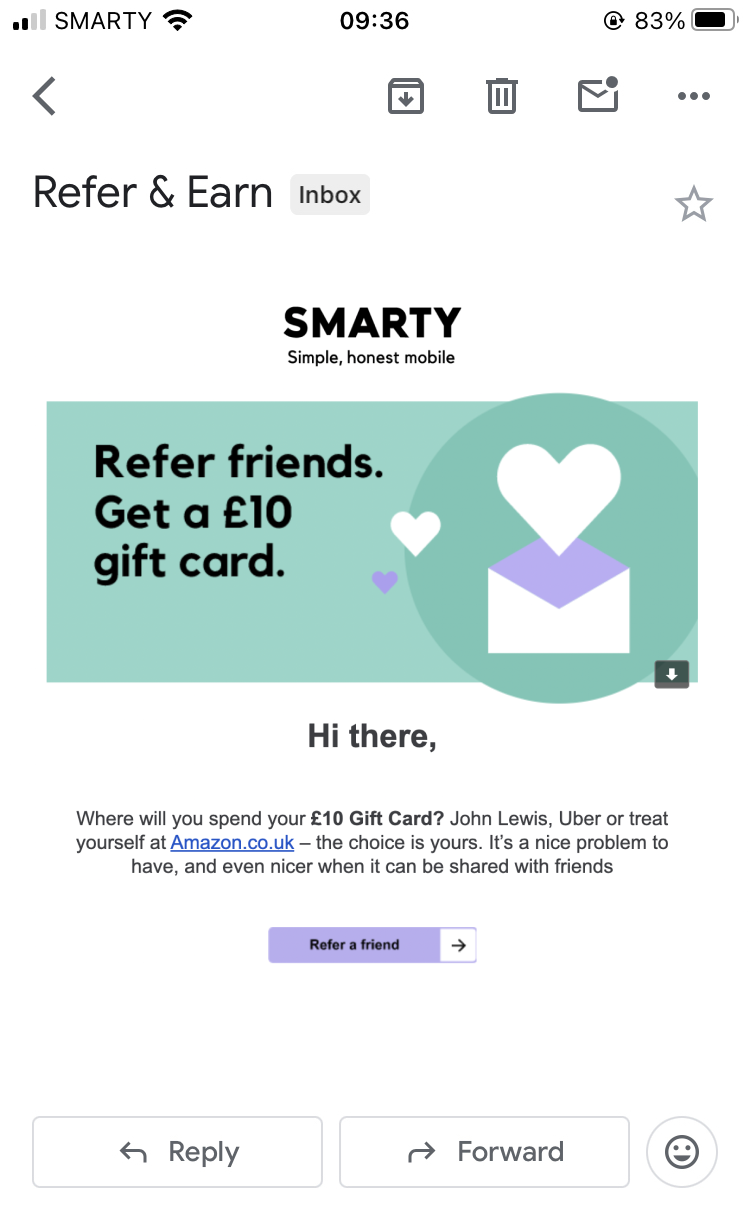
And if you’re writing a personalized email to each customer, then this is the perfect opportunity to refer to something relevant to that individual customer, such as how you appreciate that they have been a loyal customer for [X] years and, even, that to recognize that fact they can get extra referral rewards or bonuses not available to other customers. You’ll also be able to remind customers why it would be a good thing to refer a friend, remind them of the good experience they’ve had and that their friends will surely also have. You can add social proof, by mentioning your star ratings or how many people successfully referred, and you can sell the attractiveness, not only of the referral rewards but also incentive for the friend. Selling the attractiveness of the rewards and incentives can’t be underestimated as our Reward Revolution research found that fully 74% of people expressed that they wouldn’t be willing to refer without a reward and the majority or respondents said an uninspiring reward had prevented them referring at least on one occasion.
Of course all the tips and tricks for writing a good email will apply such as:
- A recognizable and trusted sender name.
- A compelling subject line that will stand out in the recipients inbox and encourage the recipient to open.
- Personalization and well written copy that reminds the recipient what you do and clearly defines what’s in it for the them.
- A clear CTA where the recipient knows what to do and what will happen next.
- A well designed user flow with attractive imagery that reinforces the call to action.
- A clearly branded UX recognizable as the brand with which the recipient has a relationship – and leading to a white label and branded landing page with no supplier or other third party logos present.
Newsletters
While there’s a limit to how many dedicated emails you can send about your referral program, if you send regular newsletters, this is great opportunity to make sure your referral program is always included. Use simple header and footer navigation, callouts in the text, or small panels to mention the program. Here the text can simply be ‘Refer’ or ‘Refer a Friend’ and, in many cases, the effect may simply be subliminal to remind your customers that you have a program.
Text Messaging
Got your customers’ mobile numbers? Perfect. Just remember to get their marketing permissions first. Given the recent issue Robinhood had with unsolicited messages, it’s crucial. Sending a text or WhatsApp message about your referral program can be very effective due to high interaction rates. Keep it short and sweet, like “Earn up to $150 by referring friends [tinyURL]”. While this channel can be very effective, particularly due to high open rates, we advise using this sparingly to avoid annoying your customers.
In-App Messaging
Similar to text messaging, in-app messaging can have high interaction rates if your customers have your app. But beware, overusing it can easily annoy customers. Keep these messages short and impactful, again providing more details on a landing page for those who want to click through an learn more.
On Your Website
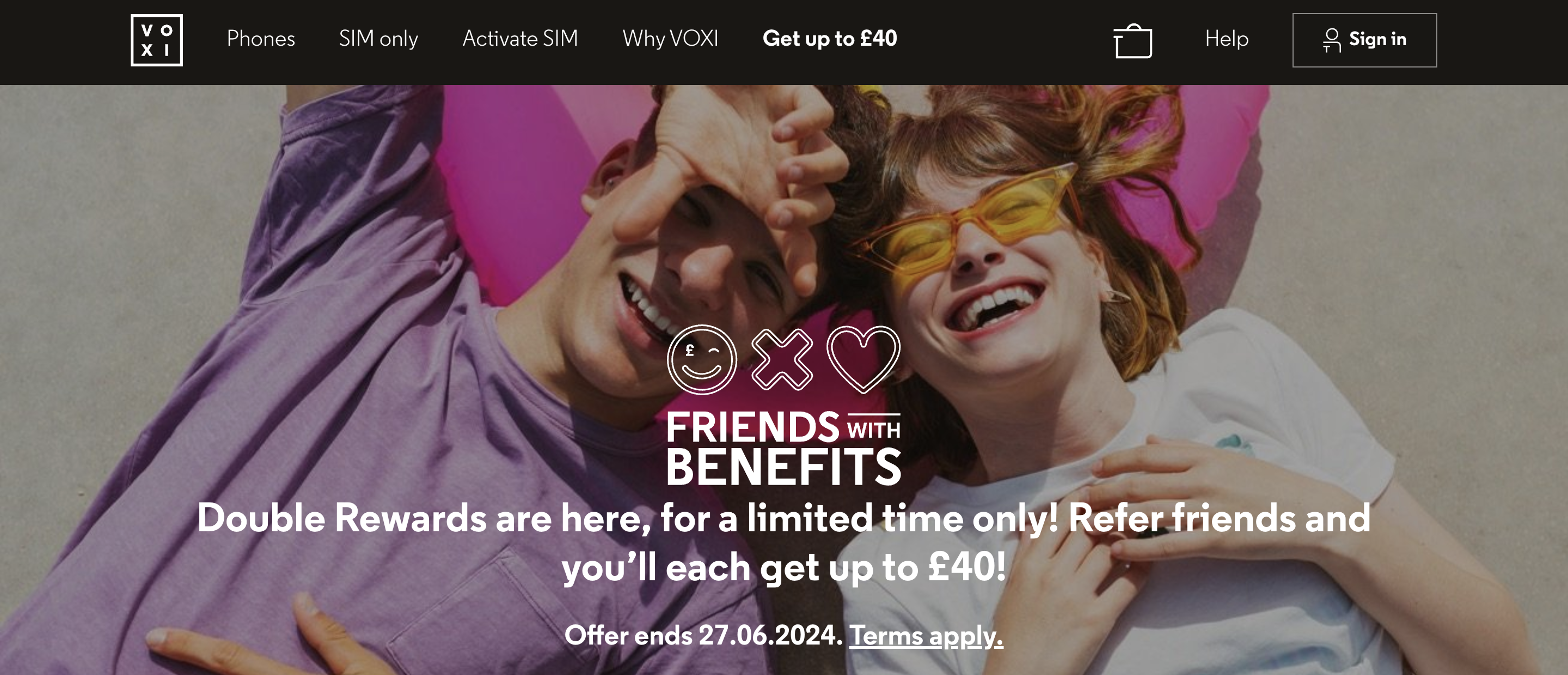
Your website is the prime spot to let customers know about your referral program. Include permanent links in the header and footer, labeled as ‘Refer’, ‘Refer a Friend’, or ‘Invite a Friend’. You can use callouts and redundant banner space to highlight your program. Ensure the URL is easy to remember and type, like BRAND.com/refer. This also helps with organic search traffic. In the example below the revered VOXI referral program uses the incentive alone in the main navigation, which directs a huge amount of traffic to the referral page.
Floating CTAs
You can boost awareness of your referral program with floating CTAs or pop-ups on your website. These can appear as visitors browse or prepare to leave your site. Use eye-catching images and text to direct them to your referral program.
Help and FAQ Pages
Mentioning your referral program in your help and FAQ pages can increase the number of referrals. Include a question like “How can I refer a friend to [Brand]?” with a link to the program. This can also help with visibility, especially in organic search results. While you typically won’t personalize the messaging, here you can explain to your customers what they have to do to refer a friend, why they should do it and what rewards they’ll get and when.
In-App Navigation
Just like on your website, include permanent navigation or callouts in your app to remind customers about your referral program.
Social Posts and Paid Social
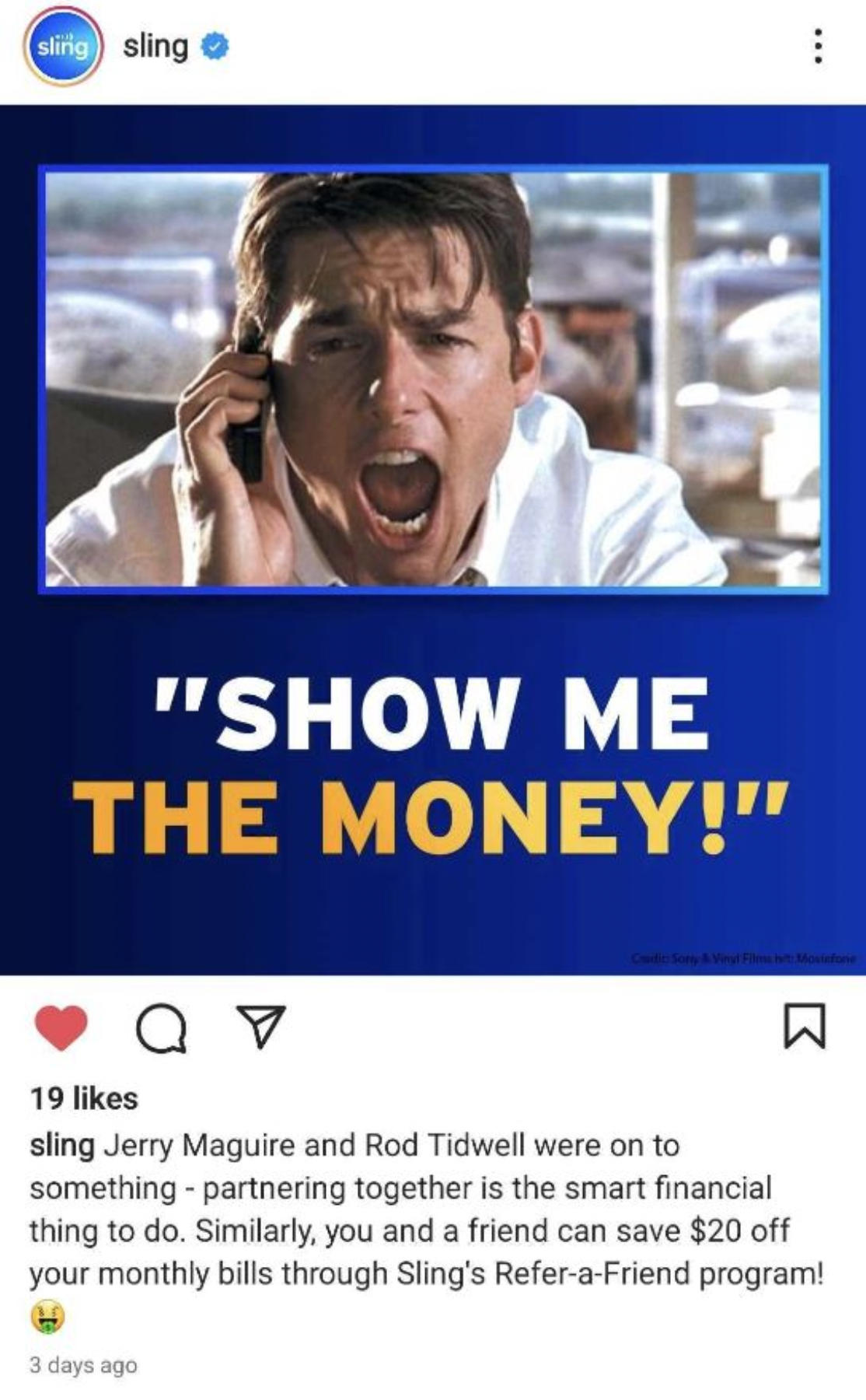
While organic social reach might be dead, social posts—paid or unpaid—can still be valuable. Use static images, carousels, GIFs, or videos to promote your referral program. Tailor the content to each platform, using eye-catching visuals and engaging text to encourage referrals.
After a Survey or Net Promoter Survey (NPS) has been Completed
When a customer completes a survey, whether identified or anonymous, it’s the perfect time to highlight your referral program. You can incorporate a message in the ‘survey completed’ pop-up or in the thank you email. Especially if you’re offering a reward, like a digital gift card, include a link and call to action in the reward email.
NPS surveys are particularly valuable. Your survey software can use conditional logic to display the referral message at the end or in the thank you emails for high scorers. Since NPS asks, “How likely are you to recommend our brand to a friend?”, a high score essentially means “I’m likely to refer you.” So, send a message like, “Thank you for your feedback. We’re happy to see you’re satisfied with our service. Did you know you can also refer friends to [Brand]?”
After a Customer has Given a Review
When a customer leaves a review, it’s another great moment to ask for a referral, especially if your review software can display a referral message to those who give high ratings (e.g., more than 4 out of 5). Much of the advice on timing and methods for asking for reviews also applies to referrals.
Hear from Buyapowa’s Director of Brand, Robin Bresnark how customers are more receptive to hearing about your referral program after a positive interaction with customer support:
Robin Bresnark: "Here's another grid this time with eight moments of key interaction between customers and brands.
Let's quickly go through them:
- So immediately after a transaction, so whether that's buying something or signing up for a service, taking out a contract whatever is relevant to you.
- After receiving a product or service, so that's once the product arrives at their door or the service begins contract starts.
- In the weeks following a transaction. You've probably got email drip automations that guide customers at this time. It works for a referral too.
- After following the brand on social, kind of a no-brainer right?
- And the same goes for after signing up to the brand's mailing list.
- And after joining the brand's loyalty program.
- Then there's once they've interacted with customer support. Now that might be asynchronous like an email exchange, or it might be synchronous over the phone or in an online chat.
- And finally after responding positively to a brand's customer satisfaction survey such as NPS.
So which ones work? Short answer they all do.
Longer answer, well this one really surprised me: The number one answer to when are you most responsive was after interacting with customer support. Really didn't expect that but it makes so much sense. That interaction, that human connection is going to inspire more human connections with friends, family members, neighbors, colleagues...
Call Centers
Call centers provide another chance to mention your referral program and ask your customer to refer. Whether through the operator or a recorded message asking for customer feedback, it’s an obvious opportunity. If your operative asks if the customer achieved their goal and is satisfied with the service, this is the perfect moment to mention the referral program and get permission to text them the link. Of course, in a person to person conversation, the message can be personalized and the benefits of referral explained. Your call center team will obviously need a script to do this.
“So which [channels] work? Short answer they all do. Longer answer, well this one really surprised me: The number one answer to when are you most responsive was after interacting with customer support. Really didn’t expect that but it makes so much sense. That interaction, that human connection is going to inspire more human connections with friends, family members, neighbors, colleagues…”
Robin Bresnark, Director of Brand – Buyapowa
Chat and Chat Bots
Chat conversations, whether with a human or a bot, are also prime opportunities to ask satisfied customers to refer. The key advantage here is that you can personalize the message and easily add the referral program link in the chat conversation.
Outbound Phone Calls
If you make outbound calls to customers, whether for surveys or upselling, this is another opportunity to ask for referrals. Provide a simple script for the call operator with guidance on identifying happy customers. This is also a chance to personalize the message and get marketing permission to text the referral program link to the customer.
In-Store
If you have physical stores, they offer excellent face-to-face opportunities to identify happy customers and ask for referrals. This can be supported by in-store digital signage, staff badges saying “Ask me about referrals,” and referral cards to give customers an easy way to find the program.
Installers and Engineers
If your business involves sending installers or engineers to your customers’ premises, such as to set up a charging point for an electric vehicle (EV) or install fiber broadband, then these are moments when your trusted experts can provide valuable personalized advice to them. And this is definitely a moment when you can drive referrals, for example with a QR code, by making the referral directly on a phone or tablet or even by leaving a leaflet with a code.
Referral Cards
We recently blogged about how referral cards can boost referrals, both online and offline. These simple tools are often overlooked but are very effective.
Email Signatures
For staff sending out personal emails, include a link to the referral program in the email signature. This can feature an image, call to action, and link, typically used in B2B contexts.
After Surprising and Delighting Your Customers
When you surprise and delight customers with a reward (like for a birthday, anniversary, or random act of kindness), they’re likely to be happy. This is a great opportunity to include a referral message in the initial communication or shortly thereafter.
After and During a Referral
Customers who have already referred you, whether the referral is complete or in progress, are great candidates to refer you again. You can use all communications during and after the referral to ask for more referrals. You can utilize gamification with tiered rewards, milestone incentives, and boosters with deadlines to create FOMO and increase the number of referrals. Buyapowa includes features to encourage more referrals both in all communications and the referrer’s personalized dashboard.
Get a Trusted Partner to Ask
And finally, don’t forget that it doesn’t have to be you who asks for the referral. If your customer came to you via a partner, broker or intermediary, then that person or company may have a better relationship with the customer and be better placed to ask for the referral at the right time, using all or any of the tactics listed above. So remember that you can get referrals beyond the immediate reach of your own business, and you can implement referral solutions with all your partners.
So what’s the best way to ask for a referral?
Well the answer is as Disney movie cliché as you’d expect, it’s a healthy combination of these channels. You could inspire one customer with a perfectly timed email while another, will be swayed after a great customer service call but one thing we do know, is that all these channels individually increase the likelihood of a customer referring by at least 180%. Our recent in-depth research into the marketing and promotion of referral programs given our clients customer persona, industry and age group specific insights into the best performing channels. Here is a sneak peek of the data:
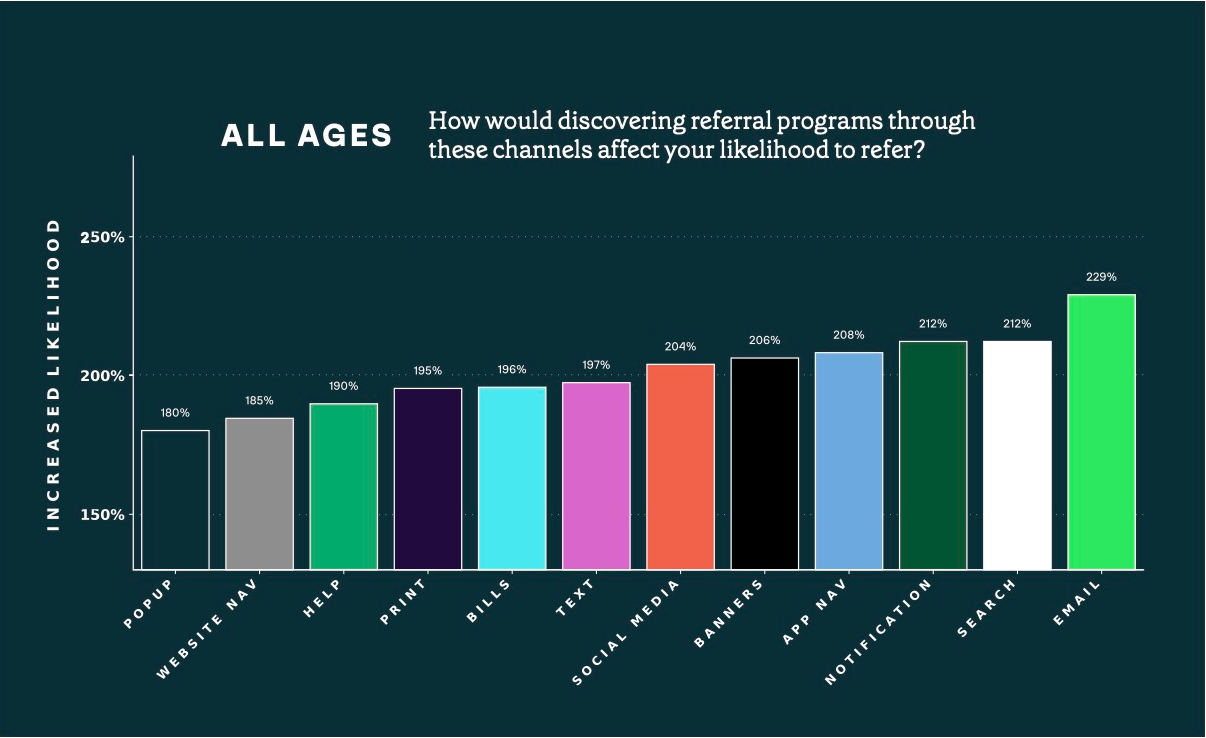
Email promotion is the channel most likely to give the biggest boost to your refer-a-friend program. But even the channel on the far-left – popups – is going to make someone 180% more likely to refer their friends. That’s almost three times as likely. That’s the takeaway- none of these channels are without merit. In fact, they all work and they’re all incredibly powerful, because people want to hear about your programs. So, instead of using this data to pick one channel to promote your program, use it to pick a blend of channels which will work across your entire audience-base, in the industry where you operate.
Active vs Passive
As mentioned, the various channels you can use to alert customers that you have a referral program can be broken down into active and passive promotion.
Active promotion is where you push the existence of your referral program to your customers via emails, newsletters, letters, text messages and in-app messages etc. These can be further broken down into messaging that allows you to detail the benefits of the referral program in the communication itself (such as in a dedicated email) or where the communication is short (such as a text message) but the benefits of participating are spelled out on a landing page and the main aim of the message is to get the recipient to click through to that page.
Passive communication is adding navigation, call outs and footer links on the website, app, FAQs and in transactional letters. Often the purpose here is to remind customers, who may already have received an active communication, that you have a program and keep it top of mind when a friend asks for a recommendation for a new telephone provider or insurer etc.
When should you ask?
Obviously, some of the examples above are triggered by an event, like a transactional email following a purchase, or a follow-up email after a customer completes a review or NPS survey. It could also be an app notification when a user visits the app, or a referral email triggered by a customer making a referral. The article by Andrew Chen of Andreessen Horowitz provides interesting insight as although he advocates asking as many times and in as many places as possible, he also points to the importance of asking during the initial onboarding flow.
“The real question is, WHERE do you make the ask? And my answer is simple: Ask many times, in many places, with different messages, and in-context with whatever action you’re asking the user to take…..Thus, make the referral ask part of the main flows….And add it to the onboarding flow, and at the end of key transactions when the user is otherwise done.”
Andrew Chen, Partner at Andreessen Horowitz
Surprisingly, the number one answer to ‘When are you most responsive?’ was ‘After interacting with customer support’ in our 2024 study. But, when you think about it, it does makes sense. That interaction – that human connection – is going to inspire more human connections, with friends, family members and colleagues. 35% of customers also opted for “after joining a loyalty program”, “signing up to a mailing list” or “responding positively after an NPS survey”, when asked when they are most open to learning about a brand’s referral program. But if in doubt, we’ve compiled an research-based; go-to list, of the best times to ask:
- Immediately After a Transaction.
- After Receiving a Product or Service.
- In the Weeks Following a Transaction.
- After Following Your Brand on Social Media.
- After Signing Up for Your Mailing List.
- After Joining Your Loyalty Program.
- After Responding Positively to a Customer Survey.
- After Interacting with Customer Support.
When communication isn’t tied to an event and is more of a marketing push, like a dedicated email, newsletter, or text message, timing is key. You can use insights from your Email Service Provider (ESP) or text provider to determine the best days and times to get a response.
If you have a personalization platform, leverage it to send messages at the optimal time for each customer. For instance, if Joe is most likely to open emails at 10 am on a Saturday, that’s when you should reach out.
As a general rule, ask for a referral as soon as you identify a satisfied customer. The feel-good sensation is most powerful immediately after a positive experience. To identify satisfied customers, look for proxies like repeat purchases, upgrades, or positive social media posts. An innovative approach we learned from Gemseek involves analyzing high NPS respondents across several data points to model other customers with similar profiles who are likely to be satisfied and therefore good candidates for referral requests. No doubt, AI-driven solutions will soon enhance this process.
Some general tips on communication style and tone
Given the wide range of different opportunities and channels to message potential referrers about the existence of your program and the fact that some will be active and others passive promotion, and the character and image limitations of some channels, it’s difficult to give advice for each channel in one blog article. But here are some general best practice guidelines that can apply to all referral promotions:
Don’t directly ask for a referral in your first communication
Although you definitely should use passive promotion such as links in the footer or email signatures in all communications, you should probably first build a relationship of trust with your customer before asking directly. You can do that by first providing a regular stream of valuable information and tips in newsletters and other communications and, of course, having retained the customer for a specified time period.
When you ask, ask in a natural way
When the moment is right to ask directly, you should ask in a natural and non aggressive and non salesy way such as asking if they have a friend who could also benefit from this product or service. This will be easier if you’re reasonably confident that your customer is satisfied or very satisfied before you ask for a referral.
Personalize
No-one likes to feel that they’re getting a generic blast. If possible, as well as using the customer’s name, the communication can refer to something personal about them, like that they’ve been a customer 2 years or they’ve reached level X in a game etc.
Make your customer feel special
Especially if your referral program is only available to selected customers or if extra rewards are available to special customers, you can communicate that your referrer has been selected as a special ambassador or as a member of a privileged community. This can work if you’re already including your customer in a community as part of a Customer Led Growth strategy.
Tell your customers what’s in it for them
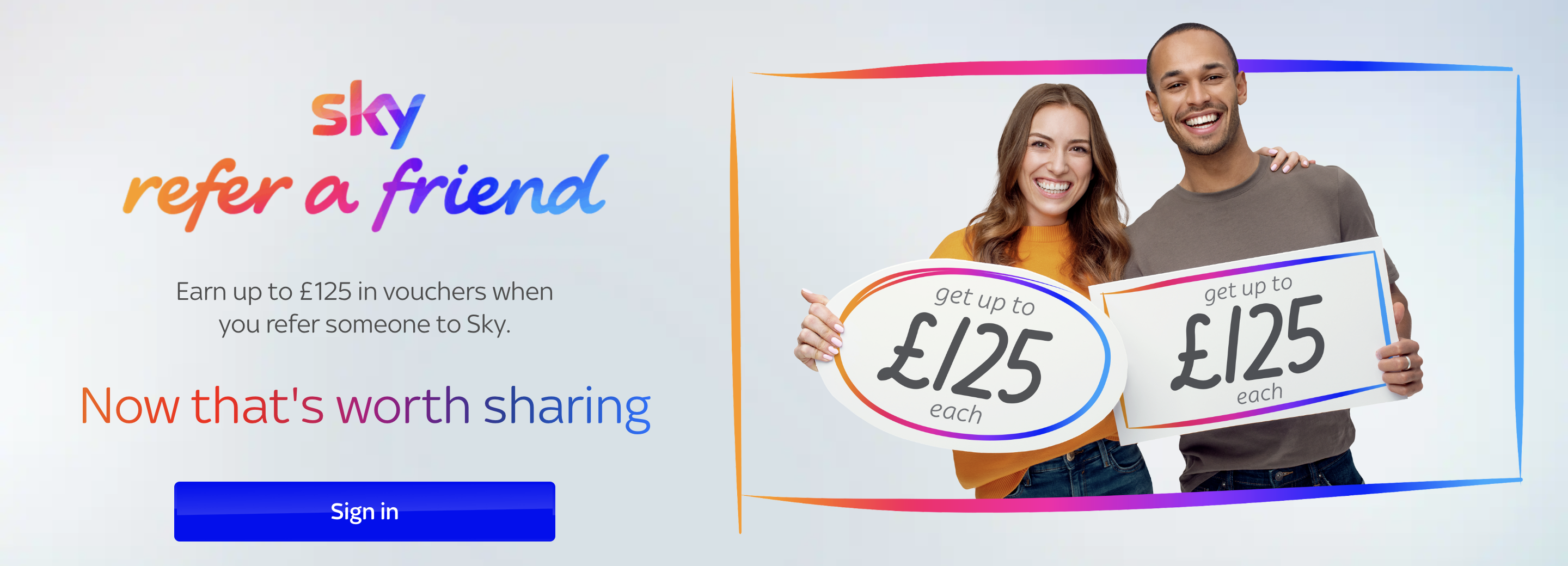
Research from Yale highlighted the importance of customer rewards in encouraging referrals by overcoming the psychological barrier to referral, namely the fear that a referral could turn out to be bad. Of course, the reward should not be too generous so as to encourage unwanted behavior, like spamming, but you should highlight the extrinsic reward for referral. In many cases, you can use the framing principle by alluding to the maximum value of rewards a referrer can earn in a year e.g. where there’s a cap of 10 referrals a year and each earns US$25 you can state ‘earn up to US$250’. That sounds a lot more enticing that ‘earn US$25 for each referral’.
Tell them what’s in it for their friend
The key difference between a referral and a normal transaction is that a referral involves a third actor: the referred-in friend. Research from Harvard found that it was important to emphasize the deal on offer for the friend. That’s because a referrer often wants not just to give a good recommendation to their friends, but also offer them a good deal as well.
Use the psychological principle of reciprocity
The principle of reciprocity states that we humans are hard wired to reciprocate when someone does us a favor or gives us a gift. In the context of referrals, you can create a desire on behalf of your customer to repay your favor by referring a friend by giving them a compliment, a free upgrade or surprise and delight gift. Obviously, you should suggest they refer as soon as possible after they have received the compliment or gift. Generally, as evidenced by Cialdini, getting your customers to like you will increase their propensity to do business with you, so you should think of all the ways you can develop liking by making your customer feel appreciated, including just saying ‘thank you’ or ‘we like you’.
Remind them that they will be helping their friend solve a problem by recommending you
As well as the extrinsic benefits of getting rewards and incentives, a good tip is to remind the referrer of the benefit that they get from your product and service and that if their friends have the same problems, that by sharing they’ll also benefit. This can be alluded to by asking ‘Do you have friends who would benefit from [what you do]’.
Remind your customer that they appreciate your product or service
If you know your customer is happy with your product or service, perhaps because you just asked them in an interaction with your call center or chat bot, or if they just gave you a great NPS or review, or if you have some other means to gauge satisfaction, then it’s a good idea to remind them of that. Perhaps you don’t want to be too presumptive, but you could thank them, mention how they manifested their satisfaction and ask them to refer. For example: “John thanks for your great review. We’re really delighted to hear that you’re enjoying our service and wondered if you could think of any friends who might also benefit from our service? Did you know we have a referral program….”.
Use social proof to show your potential
Now while your customers may have had a great experience with your product or service, they may wonder if that’s the case with all your customers. So this is a great opportunity to show social proof that you have ‘one million satisfied customers’ or an average customer rating of 4.5 over ten thousand reviews etc. It can also help convince the friend to give your offer a try.
Be clear and specific in what you’re asking then to do
While we’ve added a lot of tips above, the most important thing is that it’s clear and obvious to your referrers what you’re asking them to do and how, and what will happen next. This requires clear language and clear CTAs. The familiarity of your referrer with the concept of referrals will determine how much you need to explain.
Remind your customers that they too were referred to your brand
If you know that your happy customer was referred to your brand, then reminding them of this can drive referrals. Recent research from Rachel Gershon of UC San Diego and Zhenling Jiang of the University of Pennsylvania found that by simply reminding a customer that they were referred to the brand can increase the likelihood of getting a referral by between 20-27%.
Keep in short and simple
Finally, in a world when all our customers have busy lives, less is more. The shorter and more concise you can make the communication, the better. In many cases, due to the nature of the channel, the initial communication must be short, but you can provide more detail on the referral program landing page with links to additional information where required to keep the program clean and simple.
Next Steps
We’ve generated a wealth of knowledge having powered over 350 enterprise referral programs across the globe over the last decade. We’d love to share what we’ve learned with you. Please feel free to get in touch if you’d like to learn more.