


Referral marketing has become a staple for every marketeers toolkit, given that it drives higher value customers who not only spend more and spend longer with your brand, but are also more likely themselves to refer new customers. It’s the fastest-growing form of promotion out there, and it’s hard to find a successful brand without a referral program these days. It’s beauty, of course, lies in its simplicity: your customers get rewarded for spreading the word, their pals get to benefit from unique deals, and everyone leaves happy.
And referral has clearly become a standard behavior for customers, with 95% of customers reporting having referred a friend in the past year and eight out ten customer expecting to be able to refer their favorite brands. But, just because referral’s simple, that doesn’t mean there aren’t a number of things that can go badly awry. Sidestepping these pitfalls is easy (especially if you select a referral platform designed to avoid them), but it pays to know what to look for.
And that’s exactly what we’re here to do – in this article, we’ll outline what we have found to be the biggest pitfalls and share examples of brands that have stumbled into them, as well as those that have expertly navigated the waters of referral marketing. Let’s get into it…
1. The wrong rewards and incentives
Rewards and incentives are the basic building blocks of any referral program, driving sharing and shopping in turn. But it is always necessary to offer both? Well, yes… and no. Rewards are almost always essential: if your fans and customers are going scratch your back, it’s only right that you scratch theirs in return. Incentives, meanwhile, aren’t strictly necessary but keep in mind that people are much less likely not only to shop but also to share if they feel they’re simply advertising on your behalf by offering their friends your standard proposition.
Our Reward Revolution research found that 74% of respondents said that they wouldn’t refer without a reward and 70% said that an uninspiring reward had prevented them referring a brand in the past. And research from Harvard found that when given a choice of whether to split a reward, keep all of a reward or give the reward to the friend, the majority chose to give the reward to the friend – which shows why you shouldn’t underestimate the effect of a friend incentive in encouraging a referral in the first place. And when it comes to the referred-in friend themselves, our research found that almost 70% of people report that they wouldn’t act on a referral from a friend without an incentive.

This campaign from ICS Learn deliberately balances the two: £100 Amazon voucher to the referrer and £100 discount for the new customer. But every brand and every program will be different.
For example, we’ve often seen in referral programs that we’ve powered for clients that men often tend to share selfishly (so rewards should be emphasized), while women share altruistically (emphasis should go on the incentives). So, instead of copying a referral program you’ve seen elsewhere, be sure to consider your own brand and customer base carefully to ensure success.
Hear from Buyapowa’s referral experts as to the worst referral mistakes:
Referral marketing: Worst referral mistakes
Gideon Lask: "I'll let you guys into a secret. We are sadly nerdy about all things referral. And in our spare time we look at hundreds and hundreds of referral programs. I'd love to hear from you guys what you feel are some of the most common mistakes made by people with their referral programs what makes a referrer stop in their tracks or a friend say 'I'm not participating'?
Robin Bresnark: "Number one for me it doesn't look like a core thing the brand is doing. It's an afterthought. The worst case of this is when the program is hosted on a microsite with a different url. Maybe whoever is providing the software has got their brand all over it. Maybe that's the url that the referral might share with their friend. Maybe it's referral platform.com - that's awful."
Gideon Lask: "So it needs to be trustworthy, on-brand, integrated into the experience."
Robin Bresnark:"Yeah if I'm your friend and you want me to shop at this shop don't go telling me about some referral platform. That's horrible."
Gideon Lask: "Got it."
Peter Cunningham: "I agree with Robin. It's between the brand and the customer, so no one else should get in the way. I think the offer needs to be clear. It needs to be clear what you can get, what your friend can get and what you need to do. So that needs to be spelt out just really clear. Another thing you need to be clear about is what's happening with any data you're giving. That data is it going to be resold? Are you going to be hawked to any referral program out there. So it's very important that your supplier doesn't share that data with anyone they shouldn't."
Gideon Lask: "I know I'm asking the questions but I've got an answer as well. I hate it when they don't promote
the program because I need to be able to find the referral program if I'm looking to refer or if I'm minded to refer because I've just had a great experience, ask me to refer. Don't hide these things."
Robin Bresnark: "Yeah if someone comes to your website looking for your referral program you've got 10 seconds until they go and look at cat videos. So put it in the places they're gonna find it."
Peter Cunningham: "And give it a url that makes sense, so it's brand.com/referral."
Gideon Lask: "And rewards which are commensurate with the experience as well. If you're asking someone to join up, then offer them something good don't be tight about it. Thanks guys."
2. Keeping it a secret
Just like any other marketing channel, referral is a funnel – so the more you put in at the top, the more you get out at the bottom. That means that the biggest mistake you can make when running a referral program is failing to tell your audience of fans and customers all about it. After all, you might have the greatest program in the world but, if no one discovers it, that’s not going to make the slightest bit of difference. Luckily, there are a huge number of great ways to promote your program – from simple eye-catching emails like the ones sent from Voxi to their database of customers, to app notifications fired out by Buyapowa clients such as Vodafone. Want even more ideas? Check out our guide to promoting your referral program or you can always get in touch.

3. Limited sharing channels
If customers are going to do something for you, they’re not going to jump through hoops for the privilege. One of the key ways to keep everything moving is to make sure that their favorite channels are available for them to share your referral proposition with their friends.
Sadly, many brands still assume that email is everything. Don’t get us wrong: despite the dozens of new sharing channels available today – from social networks to messaging apps to native mobile tools – email is still, by far, the most commonly used channel.

But that doesn’t excuse the long-winded manual forms (like the one we found plaguing a well-known UK brand’s referral scheme). We’ll get into a very particular danger inherent in forms later in this article but, for now, what’s noticeable is the complete lack of any sharing channel besides email. No Facebook, no WhatsApp (the two bare minimum additional channels); nothing. So, if you don’t know all your friends’ email addresses, you’re flat out of luck. And so, of course, is the brand that’s seeking your referrals.
Of course, inexplicably, we still see some offline referral programs out there!
“I hate it when they don’t promote the program because I need to be able to find the referral program if I’m looking to refer or if I’m minded to refer because I’ve just had a great experience, ask me to refer. Don’t hide these things.”
Gideon Lask, Founder and CEO – Buyapowa
4. No default sharing message
Some referrers are amazing. They craft clever messages to their friends, record impassioned videos or design impactful images which really sell the brand in question and, in turn, increase the number of successful referrals they achieve. Some, but by no means all.
Most referrers – no matter how engaged – expect to be able to hit ‘share’ and move on. And that’s fine, unless the referral program doesn’t do the heavy lifting on their behalf.
Here’s an example. We went to the movies last week, and we were excited to see that the cinema chain had launched its own ‘recommend-a-friend’ scheme. We signed in, we hit ‘share this offer’, and we opted to tweet. And were then presented with this:
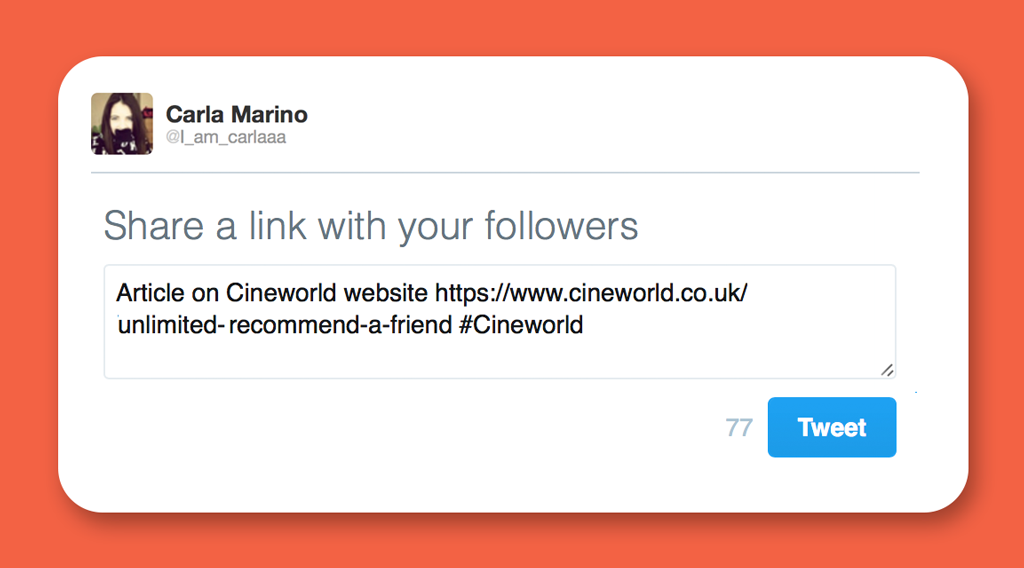
Thanks, but no thanks. No matter what platform you use, you ought to be able to pre-populate your default sharing messages. And they’re important because they’re your only opportunity to make an impression on your customers’ friends. So, tell them: what’s great about your brand? Why should they click through? If you don’t provide this basic information, don’t be surprised when your program fails to catch fire.
5. Settling for single referrals
Ask most people what constitutes a successful referral scheme and they’ll say it’s anything that encourages a user to sign up and share, and a friend to click through and shop.
This is a mistake. A successful referral program recognizes that, once a fan or customer has achieved one referral, they’ve proven their ability to attract new customers. And it does everything in its power to ensure that they keep sharing and that their friends keep transacting.
Here at Buyapowa, some of our clients regularly see 10, 20, or even hundreds of referrals generated by their most active advocates. In fact, across all our clients, one in every 50 referrers is responsible for almost 20% of all referrals.
There are many ways to encourage multiple referrals – from refreshing your program to building in gamification or, like British Gas, introducing tiered rewards. But, whatever you do, don’t settle for one referral per advocate when you could be achieving so much more.
6. Overlooking mobile users
Mobile has taken over e-commerce, with over 70% of all sales taking place on smartphones and tablets. And that trend is even more pronounced when it comes to referral, with an even greater percentage of all sharing taking place via mobile. That’s why serving up a mobile experience that’s not just responsive but tailored to a user’s device is absolutely critical. Yes, it needs to look right, but it also needs to serve up the sharing channels most likely to be used by any given user at any given time.
Hear from Buyapowa’s referral experts why you should consider making your referral program open to anyone:
Referral marketing: Should your referral program be open to everyone?
Gideon Lask: “Peter, Robin, one of the questions I'm asked all of the time is whether someone should open their referral program up to everybody or limit it just to their existing customer base? Is there a one-size-fits-all answer to that or does it differ based on the client and brand?
Peter Cunningham: “There's no one-size-fits-all answer, it depends on what you want. So if you restrict it to current customers, yes the referrals will be much more persuasive, because you've got a current customer saying ‘I use this product’. But you're restricting the number of people that could refer you. So we have some customers that say just anyone can refer and some people put it behind a login and they require an AA membership number or Vodafone telephone number or an account number from a bank etc so you can get in to refer. But again, it depends what you want, If you've got a business objective to encourage people that are only members of your loyalty scheme to refer, you might want to restrict it. If you want the most number of referrals we would say leave it open.”
Robin Bresnark: “And there are many times when someone will not themselves be a customer, maybe they're a lapsed customer, maybe they were a customer but they might not be a customer right now. Good example: a person A lived in New York and with a particular cell phone company they had an amazing signal and they loved it. Then they moved to Cincinnati and the signal was terrible there so they changed providers. That doesn't mean that all their pals back in New York wouldn't still benefit from that referral. So because they don't use it anymore doesn't mean that they can't tell their friends about it. Again if you're talking about baby products and your children are fully grown you don't use those products anymore, but you might have loved them back when you did, so there's all kinds of reasons why people might just be lapsed. Also people may love a brand but they just can't afford to get into that brand - so I might love Louis Vuitton. I’m obsessed with it but you don't pay me enough to buy lots of Louis Vuitton. Doesn't mean I can't tell my friends how amazing Louis Vuitton is.”
Gideon Lask “ So what I'm hearing is, open that funnel at the top to actually as many potential referrer as is possible, but if you have very good reasons for locking it down, maybe it's an employee program only open to your employees, we have good tools and ways of doing that. So we're flexible but ultimately it's a funnel. The more customers at the top the more new customers at the bottom.”
7. Your name’s not down. You’re not coming in
One of the biggest mistakes brands often make when first setting up their referral programs is needlessly excluding people who aren’t existing customers from participating and referring their friends. Sometimes, of course, it’s important to ringfence your scheme – and, here at Buyapowa, we actively encourage it for more heavily regulated clients like The AA or the global online gaming company, Kaizen Gaming. But often there’s absolutely no reason to exclude non-customers as a default. After all, I myself might not have any need for the latest L’Oréal silky smooth hair products, but there’s no reason whatsoever why I shouldn’t recommend their products to my friends with luscious locks.
So, think before you block. And, wherever possible, keep the door wide open.
“So what I’m hearing is, open that funnel at the top to actually as many potential referrer as is possible, but if you have very good reasons for locking it down, maybe it’s an employee program only open to your employees [you can do that], but ultimately it’s a funnel. The more customers at the top the more new customers at the bottom.”
Gideon Lask, Founder and CEO – Buyapowa
8. Omitting omnichannel referrals
Referral marketing is nothing new. For centuries, customers have been encouraged to “tell their friends”, and a friendly name-drop to a shopkeeper would often secure a few pennies off the bill or an extra slice of bacon in the bag. But, ever since technology allowed the referral process to be digitized, we’ve tended to view it as such a modern phenomenon it can only possibly take place online.
That’s a mistake and yet, ironically, it’s only the most recent technology that’s allowed us to correct it. It’s now entirely possible to track referrals all the way from digital shares to in-store purchases or sign-ups via a call center, meaning that referred-in customers are finally able to shop online, on mobile, over the phone, or even at brick-and-mortar outlets.
This makes all the difference when it comes to purchases that aren’t always made online, especially big-ticket items like mobile phone contracts. That’s why brands such as Vodafone can now give referred-in shoppers the opportunity of transacting wherever they choose – and it’s why their referral program is a huge success. Make sure yours is, too.
9. No Social Proof
It’s easy to forget that the referral experience is very different for referrers and their friends. The former group generally knows your brand reasonably well, and they’re well enough versed in the referral process to have become involved and started sharing with their friends.
But those friends are coming to this cold. So, when they hit your site, they need to be assured that they’ve come to the right place. And the best way of doing that is to include their friend’s name on the landing page where they arrive – just like the leading insurance provider Vitality has done in this example.

Our tests have shown that omitting this kind of vital social proof can result in 30% fewer friends clicking through to shop: a massive impact for what might seem like a trivial detail. So, when you build your referral program, make sure you don’t alienate those potential shoppers before they’ve even started to browse.
10. Cannibalizing organic purchases
One of the first rules of e-commerce is “never interrupt your checkout”. When it comes to referral, that’s even more critical. But some referral platforms break this fundamental rule and append a link to your checkout asking whether you’ve been referred by a friend – something they have to do because, instead of tracking a unique link shared by the referrer, they simplistically ask imminent shoppers to enter the referrer’s name at this stage. The obvious problem is that non-referred customers are significantly less likely to complete the checkout when presented with an easy way to save – and significantly more likely to Google a stranger’s name they can type in. The consequence? You end up paying out rewards to people who haven’t made a genuine referral, and you end up discounting the baskets of customers who were ready to shop anyway. That’s a big loss for you and a big win for any referral platform looking to take a CPA cut of your profits.
11. Neglecting touchpoints
Referral should never be ‘set and forget’, but it’s remarkable how many programs fail even to send participants an email when they first sign up, allowing them to fall into a black hole where they’re highly unlikely to engage, let alone successfully refer any friends.
People are unlikely to wake up in the morning with your referral program front and centre in their minds, so the onus is on you to reach out to them instead. SMS and app notifications can work extremely well but, generally, these touchpoints take place via email and triggered when a referrer first gets involved, if they’ve been dormant for too long and multiple other scenarios.
Ultimately, they all have the effect of re-engaging potential referrers and driving them back to your referral program where – crucially – they’re able to check their progress (how many friends have they referred? what are their goals?) and given the tools to keep sharing. Of course, the Buyapowa platform takes this a step further by automating nurture sequences to retain customer engagement with specifically targeting messaging, and of course, it takes all the weight off our clients’ shoulders.
Our Referral Codebreakers research found that customers not only expect a brand to tell them it has a referral program, but would like to be reminded about it once every two months.
Hear from Buyapowa’s referral experts how to avoid breaking data protection laws:
Referral marketing: Does referral contravene privacy legislation?
Gideon Lask: "So, gentlemen, you know what a conservative, law-abiding individual I am. "
Robin Bresnark: "Yeah, famously."
Gideon Lask: "Famously. Now, in the spirit of being highly risk-averse, I'm slightly concerned that referral might fly in the face of legislation such as GDPR."
Robin Bresnark: "Yeah, it can do. When it's done badly. I keep seeing referral programs where you have to put in your friend's email address and the platform or the brand emails the friend on your behalf. Massively against privacy laws. Massively. And the fines are astronomical if you get that wrong,....which is why we don't do it. So we don't collect that kind of data. Pete, what do we do?"
Peter Cunningham: "Well, it's not just GDPR, it's CCPA and there's equivalent legislation in Brazil and Russia as well. But the interesting thing is we allow native sharing. So it's the easiest thing in the world.
You get someone who refers, "Well, you got an offer?" You want to refer, you're on your mobile phone, you go straight to your favorite app, click. You don't even have to remember your friend's details. You don't have to put in their name, their email address, their phone number, their age, where they live, their gender, whatever.
You just click, "This is a great offer."
It's very easy.
It's very safe.
You don't give any of that data to the brand. The referred friends then can decide.
They have full control, if they want to come to the brand and give that information. So we comply with GDPR, CCPA and all the others."
Gideon Lask: "Makes a lot of sense, and I guess that's why we work with the likes of HSBC and Vodafone and big banks and insurance companies."
Robin Bresnark: "They're nearly as fearful of breaking laws as you."
Gideon Lask: "Nearly, Thanks Robin."
12. Breaking the law
On May 25, 2018, the EU’s GDPR (General Data Protection Regulation) came into effect, prohibiting the collection of any individual’s data where the individual has not personally opted in. A similar law came into effect in California in 2020. Now, do you remember the form we saw in Section 3? Under these new laws, forms like these are now likely to be illegal, because they ask referrers to submit their friends’ email addresses and not the friends themselves. While you’d expect this to be a problem for most self-built referral programs, it’s alarmingly just as common with many outsourced referral platforms.

Take the forms in this image – each powered by one of the leading US and UK referral platforms, all of which risk earning their clients massive fines of €20 million or 4% of their global annual turnover under GDPR.
The Buyapowa platform avoids this potential disaster by giving our clients the option of using referrers’ own native applications to email their friends. That means we won’t collect any data from anyone who hasn’t opted in, and it means our clients are safe. Are you?
“But the interesting thing is we allow native sharing. So it’s the easiest thing in the world….You want to refer, you’re on your mobile phone, you go straight to your favorite app, click. You don’t even have to remember your friend’s details. You don’t have to put in their name, their email address, their phone number, their age, where they live, their gender, whatever.”
Peter Cunningham, Director of Marketing – Buyapowa
Be sure to follow this checklist to sidestep all the referral pitfalls – paving the way for success:
- Consider your rewards and incentives carefully
- Spread the word about your referral program
- Allow your customers to share via multiple channels
- Make use of default sharing messages
- Don’t just settle for one referral per referrer
- Optimize your referral program for mobile
- Where possible, allow non-customers to refer, too
- Enable referred-in friends to transact via all channels
- Reassure those friends by referencing the referrer’s name
- Maintain multiple touchpoints to re-engage your referrers
- Don’t reference your referral program on your checkout page
- Avoid huge fines by enabling referrers to share using their own native applications
We’ve summarised this advice in a series of podcasts on YouTube. But if you’d like to learn more get in touch.