


When it comes to trying to market a brand or product, there is no asset more valuable than a brand advocate (sometimes called a brand ambassador); those who evangelize you, your brand or your product or service to their friends, family and colleagues. No matter how well you personalize your messaging, no matter how much data you pour into your targeting, and no matter how much effort you put into reaching niche audiences, you simply can’t compete with the power and credibility of a trusted friend, family member or colleague and the ability of that person to get the message in front of the intended recipient.
That’s usually where people’s idea of a brand Advocate stops; a vague notion of what brand advocates are and an acknowledgement that they’re somewhat important. But by looking a little more closely at what they are and why they’re so important, you can unlock the ways in which you can actually create and nurture brand advocates. And once you do that with a dedicated, long-term brand advocate strategy, then you have a marketing strategy that can really drive positive change for your business.
So let’s take a closer look at who brand advocates are and what they look like, why they’re so important, and how you can create and nurture them. Plot twist on that last point: It involves referral marketing.
What is a Brand Advocate?
We mentioned earlier that brand advocates are the people who evangelize your brand, product or service to their friends, family or communities. And they can take many forms, like:
- Your existing or previous customers
- Your past and present employees
- Your business partners
- Even subject-matter experts and thought leaders
All of us are brand advocates in some way, shape or form. Whether it’s a brand you follow and share online or a product you can’t live without and constantly talk about with friends and family. Or even a movie, restaurant or clothing brand you won’t stop recommending to people.
The above categories are all examples of brand advocates who are probably already promoting your brand, product or service to their own connections through their preferred channels, whether that’s social media, community boards or even offline conversation. The trick is finding them, and motivating and equipping them to do more for you.
A little something to think about: Influencers are not necessarily brand advocates. While yes, there are some influencers who recommend brands they already know and love without expectation of payment, in other words where they themselves are genuine customers, this isn’t typically the case. The relationship between an influencer and a brand is usually more of a transactional nature, akin to paid promotions. And because their communication can often be scripted and tightly controlled by the brand, there’s no guarantee as to the authenticity of their opinion. Obviously, consumers are aware of this, as recent research from the agency UM, quoted in The Drum, found only 4% of people trusted information from Facebook and Instagram influencers.
Brand Advocate vs Brand Ambassador
The line between brand advocates and brand ambassadors can be blurred at times. And with influencers and reviewers also having a pull on the consumers brand allegiances, the line becomes even more blurred. It’s true that advocates and ambassadors come in a few shapes and sizes and so we’ve set out a short summary of the differences below.
Brand Ambassadors
These individuals are typically officially recognized representatives of a brand, who leverage word-of-mouth marketing and user-generated content to spread positive brand messages to their audiences. A successful brand ambassador genuinely loves the product or service, and will aim to convince others to try it. In return, they are often rewarded with perks like free products or free months of service, event invites, or even monetary compensation.
Brand Advocates
Unlike ambassadors, these advocates aren’t necessarily formally recognized but nevertheless passionately support your brand. They genuinely believe in your products or services and promote them through user-generated content, positive reviews and referrals (whether online or offline). Brand advocates aren’t necessarily customers and can include employees, bloggers, industry experts or anyone else willing to vouch for you.
Customer Advocates
Customers can be your most influential marketers, offering authentic and convincing endorsements based on their actual experience of using your product or service, whether currently or in the past. Though their reach might be smaller than official brand ambassadors or influencers, they often have high engagement levels with their audiences due to personal relationships (family, friends or colleagues) and authenticity of their endorsements tend to resonate powerfully, influencing purchasing decisions among friends and family.
Influencers
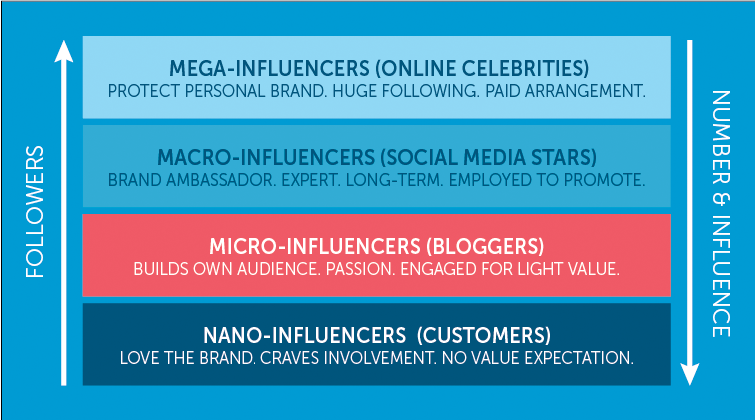
Operating under the ambassador umbrella, influencers typically have a wider reach due to their large number of followers on social media, news feeds, email newsletters or YouTube etc. Although there are many types of influencers, based on the number of followers they can reach (Mega-, Macro-, Micro- and even Nano-influencers) and whether they always expect to be paid to promote a product or service or are willing to promote based on genuine enthusiasm. Often influencers have a lot of credibility and authority, especially in niche or specialist areas where they can be seen as experts, that allows them to sway opinions and recommendations. As you can see in the image below, Mega- or Macro-Influencers often have high reach but low engagement with each of their followers, whereas Micro- or Nano-Influencers may have higher levels of engagement with each follower based on actually knowing the people who follow them, being an expert in a niche area or focussing on a small geographical area.
Industry Experts
Thought leaders in a specific industry can offer expertise and reliable information to your audience, whether bloggers or industry analysts. Their expert insights can elevate your brand above competitors and establish trust among consumers.
What does a Brand Advocate do?
We touched on this above with our breakdown of exactly what a brand advocate is. In essence, the role of a brand advocate is to engage and influence people who could use your product and service and convince them to try it.
Brand advocates leverage their reputation and relationships in order to influence the decision-making of someone in their network, whether that’s a friend, family member, colleague, business associate, follower, and so on.
They do this through a variety of means, both directly and indirectly, including:
- a personal message or a conversation over a cup of coffee
- user-generated content (videos, photos, etc.) and social media posts
- online reviews and testimonials
- blog articles and opinion pieces
- webinars
- online of offline referrals
- brand partnerships, and so on.
As we touched on earlier, the power of these brand advocates to actually engage and influence relies heavily on the trustworthiness and reputation of each particular advocate (or the favour of their audience). The reputation and influence of a brand advocate can suffer if a recommendation turns out to be a bad one, so a good brand advocate will only recommend products and services he or she really believes in.
Hear from Buyapowa’s Referral Experts on how to identify brand advocates or brand ambassadors.
Please enter correct post id for Video SEO Post
How to find brand advocates
This is the billion-dollar question, isn’t it?
Given that brand avocates are crucial for every business, how do we actually go about creating an army of advocates to help you promote your brand and acquire new customers?
Well, the answer is, in part, that brand advocates almost certainly already exist for your business and often already show up in many ways:
- Online Communities or Forums: Do you have online boards where customers or partners can give advice and help to newbies? If so, your frequent contributors are often already brand advocates.
- Reviews: If you have ratings and reviews on your website, or on third party websites, those who give you a glorious Five Star review are natural candidates to become brand advocates. While of course you should be interacting with them and thanking them for their reviews, you can also invite them to refer you to their social circle.
- Social media monitoring tools: Through tools like Cision’s Brandwatch, Meltwater or Salesforce’s Social Studio, you can identify people who positively comment about you or retweet you on social media and identify natural brand advocates.
- Influencers: If you monitor influencers, you may find some who praise your products for free. They do exist, even if they are rare! So reach out to them.
- Net Promoter Scores (NPS): Often brands spend a small fortune gathering Net Promoter Scores (NPS) from customers and then do absolutely nothing with those who answer 8 or above to the question when asked to score how likely they are to recommend us to friends, family and colleagues. We think this is almost criminal. These people just told you that they would recommend you! But too many brands just focus on detractors and do little with their Net Promoters.
- Employees: Your employees are some of your most credible brand advocates. Not only do they know your products inside and out, their likelihood to refer is intertwined with the success of your business. That is why brands like Gap have given their employees the right to offer special discounts to friends and family; an added advantage of being an employee.
- Repeat customers: The most obvious category where you can find brand advocates is among your customers, particularly your repeat customers. They show their satisfaction with you by giving you one of their most precious resources: Their money.
- Past customers: You may have a product someone loves but doesn’t need anymore. For example, if you sell great baby clothes, you may have a super enthusiastic brand advocates who won’t need baby clothes for his or her 5-year-old children but would happily recommend you to a pregnant friend or colleague.
“A lot of those people self identify. People leave positive reviews on review sites. They like your social media. They stand up for you in social media. They repeat buy. And they give you high NPS scores, so they’re actually saying ‘I do love you’. So you should be reaching out to those people and saying: ‘you said you love us, why don’t you share that love with your friends’”
Peter Cunningham, Director of Marketing- Buyapowa
So the reality is that you are likely already surrounded by actual or potential brand advocates. You just need to find them and activate them by giving them an easy and safe way to recommend you to their friends and motivate them with an incentive for their friend. But rather than stop there, you need to supercharge their evangelism with clever use of psychology, like gamification, intelligent and tiered rewards to get people sharing again and again.
The best way to do this is to launch a refer-a-friend program and to push it across all touchpoints including your website, app, client area, call center, emails and newsletters. Because, unless your brand advocate program can be easily found and unless you prompt and remind potential brand advocates to refer you, you will be relying on their natural proclivity to spread the word about you.
The Importance of Brand Advocacy
Let’s take a look at the key reasons brand advocacy is so important, from the obvious to the less obvious.
To bring in new customers. This is a key point for any business. Brand advocates are amazing at not only bringing in new customers but bringing in ones that are a great fit for your brand, product or service. Studies have repeatedly shown that word-of-mouth is the best method for acquiring new customers and creating brand awareness.
Recent research by the Keller Center for Research at Baylor University found that this was predominantly due to two reasons; namely (i) better matching and (ii) social enrichment. Better matching is explained by the fact that a referred-in customer is much more likely to fit with your brand and its offering than an average visitor to your website. The researchers broke this further down into active matching; brand advocates who actively look for people among their networks they believe would benefit from your product and service, and passive matching; the tendency of people to socialize with people who look like themselves. So not only is a brand advocate, as a good customer, likely to refer-in other good customers, but those new customers should themselves have a higher propensity to become brand advocates in turn. Finally, social enrichment occurs because your customers know your brand and products very well. Not only can they knowledgeably and credibly recommend your brand to their friends, but they can recommend exactly the right product from your offering. So not just T-Mobile, but this bundle with low-cost international calls. Or not just AXA, but this particular AXA policy.
Of course, when a brand advocate makes a recommendation to a friend, colleague or family member, that person is adding part of his or her personal trust to the recommendation. And if the relationship is valued, the brand advocacy has a vested interest in ensuring that the recommendation is a good one.
Advocacy is reliable and trustworthy. Brand advocates’ authenticity, expertise, and trustworthiness are what makes them such a powerful voice, particularly when they are personally known to the person receiving the recommendation. To illustrate this Nielsen found peer recommendation the most trusted information channel, trusted “completely” or “somewhat” by 9 out of 10 respondents. By comparison, only 56% of respondents reported that they trusted adverts “completely” or “somewhat”. So try as you might, you just cannot compete with the power that brand advocates have in turning their friends, family and colleagues into valuable customers, and it’s important to have those trusted voices working for you.
They’re cost-effective. A campaign that leverages your existing brand advocates (and word-of-mouth marketing in general) is typically significantly more cost-effective than other traditional marketing channels, including paid search, pay-per-click, influencer campaigns, affiliate or social campaigns. So when you launch a referral program, the cost of running that program and funding rewards and incentives usually pales in comparison to other marketing channels. And due to the concepts mentioned above like better matching, brand advocates are more likely to bring you better and more loyal customers, with higher lifetime values. Whereas, other channels, like price comparison websites or competitions, may bring you price sensitive switchers who will soon move on for the next good deal elsewhere.
To help onboard new customers. This is a less obvious point, but nevertheless an important one. With any product, no matter how big, small or seemingly simple, there are barriers to becoming a new customer and using the product. Whether it’s new features to figure out, an unfamiliar website to navigate, or even a pre-existing opinion about the brand itself to overcome. Brand advocates are great at removing barriers, reducing friction and helping to onboard new customers. In particular, given their knowledge of your products and services, they are able to recommend the exact product or service that will suit the new customer, due to the social enrichment factor, which should reduce issues with adoption. And where a brand advocate has recommended or referred a friend, that advocate has a vested interest in ensuring that the friend has a good experience.
You can check out some of our best practices here, and if you would like to know more or you’re interested in launching an advocate program like refer-a-friend, don’t hesitate to get in touch.