


In a previous blog, we discussed what referral tracking is and why it’s important to be able to track, measure and optimize your referral program and to show the value that it drives for your business. This blog focuses on the two main ways to accurately track referrals: Referral Codes and Referral Links.
Below we’ll explain each of these tracking methods, the differences between them and the advantages and disadvantages of each, and when you might want to use one or the other, or combine both options in your referral program.
What is the purpose of a Referral Code or Referral Link?
The purpose of a referral code or referral link is essentially the same. In the context of a referral program, both allow you to quickly and cleanly identify the person who was responsible for bringing someone to your website, call center or premises, and where that referred-in person carries out an action that has value to you, such as a purchase, subscription or app download etc., attribute that action to the referrer. This enables you to recognize the referrer and follow through on the promise to reward referrers for each and every friend or family member they refer to your business. The process of matching the referrer to a the friend they referred to your business is known as reconciliation, and without some unique identifier such as a code or link to reconcile a referrer with a transaction, this becomes very difficult and time consuming, if not impossible.
Hear from Ollie Moore, AVP, Product & Member Marketing at Delta Community Credit Union, as to why you need to keep your referral program simple and easy to use:
Is your referral program simple enough? | Delta Community Credit Union
Ollie Moore: "You want to make sure that your referral program is simple."
"One of the things that we do love about our program is the ease, the simplicity of it. So that our members don't feel like they have to share too much of their information."
"They don't really have to share anything. Just a link to their friends and family."
"Before we partnered with Buyapowa, there were some things that were clunky there. When we did have it where you'd have to have the member's name. Or where the member would go by a nickname in their personal life but for their banking they would go by the formal name."
"You know a unique link that each member can use to bring their family and friends on, works just perfectly and smoothly. And we think it encourages people to use the program even more so."
See the full video here.
Referral codes and links also allow referral programs to comply with data protection provisions, like the GDPR or CCPA, as, unlike with many in-house built referral programs, the referrer doesn’t have to enter details of their friend in a form on the brand’s page, for the brand to then contact the friend. Instead the referrer simply shares the code or link with the friend who decides whether he or she is interested and wants to visit the brand’s website and voluntarily provide their personal information, either as part of the purchase or via a data capture form.
You want to make sure that your referral program is simple. One of the things that we do love about our program is the ease, the simplicity of it. So that our members don’t feel like they have to share too much of their information. They don’t really have to share anything. Just a link to their friends and family.
Ollie Moore, AVP, Product & Member Marketing – Delta Community Credit Union
In short, referral links and codes are the backbone of your referral program. When you work with a sophisticated referral program provider like Buyapowa, all of the information gleaned from these links and codes is stored in a database and made available in a user-friendly interface that let’s you interrogate the data and see how many referrals you got, who referred whom, how many referrals each referrer drove on average over the period, which campaigns drove the most referrals etc. and any other questions you have about the performance of your program. This data and the analytics produced from it, together with benchmarks and a best practices from a referral expert, are what allow you to pilot your program and constantly improve the performance over time.
If it wasn’t for the codes or links, none of this would be possible.
What is a referral code?
A referral code is a unique identifier, which can be any combination of alphabetical, numerical or alphanumerical characters as long as it is unique to the referrer. A referral code is technically similar to a coupon or voucher code in that by applying the code as part of the conversion process, for example before or after checkout, it allows the user of the code to benefit from the promise made by your brand, whether that’s a discount, a free product, a third party gift card, cash payment or bill credit etc. The main difference is that the a referral code needs to be unique so that the user also identifies the person who gave them the code (i.e. the referrer) when inputting it in the conversion process.
You can create unique referral codes in various ways, including using a random number generator in Excel or Google Spreadsheets, or you can find some simple and free referral code generators online. However, you need to make sure that each code is unique to avoid a confusion as to who the referrer is. And so you can see how these manual solutions are only suitable for very small scale referral programs and quickly become cumbersome and unworkable. Which is why you’d be well advised to use a referral marketing platform, like Buyapowa, which can provide you with codes, keep these stored safely in a database and make sure all of these are unique and can be matched to a referrer.

Some referral platforms allow referrers to create their own referral codes, often using their names or their names with some additional letters or numbers, or alternatively create a pseudonym like pinkelephant213. The advantage being that these can be easier to remember for both the referrer and the friend. Additionally, where the code uses part of the friends name, this can feel more personalized for the friend being referred, which can positively affect the likelihood of conversion. It can also be possible to combine the brand in the referral code as a ‘vanity code’, to create a branding effect, for example like Honda-JamesSparks221.
There’s always a tension between being able to give a referrer a code that’s short enough to remember and use but long enough to give you enough permutations to cover all the unique referral codes you need, not just today, but for the foreseeable future. In most cases, with a digital referral program, a referrer will share the code with a friend directly in an email or message, whether by copying and pasting the code or using a native integration from the referral software provider that automatically adds code to the message. In many cases, the referred-in friend would simply copy and paste the code into the checkout process, so the main concern is to make sure that the code doesn’t break if copied and pasted, for example if a character is missed when copying. But, often, the friend will not have the message at hand and will have to remember the code and type it into the checkout process, and could forget or mis-spell the code. Also in an offline referral process, such as with a call center or instore, the friend will need to tell the code to the call center or store staff, which will be easier if its short and memorable.
A disadvantage of using a referral code online is that the friend needs to find the URL to complete the referral action, whether your brand’s website or an individual product or promotion page. Of course, you can include this link in the message along with the code. Although, an advantage of the referral code is that it can be used in situations where a referral link cannot, for example where cookies cannot be used or with a call center or in-store. Another advantage of a referral code is that it’s easier to use in a viral context, such as where an influencer shares the offer with a personalized code, which can be more practical than sharing a link.
Hear from Natasha Saviuk, Director of Growth from Wealthsimple that, in her experience, where a friend forgets to use a referral code, letting them retrospectively apply it up to 30 days after a referral hasn’t lead to any gaming or abuse.
If your friend forgets to use the referral link | Wealthsimple
Robin Bresnark: "One thing that you guys do, is that you can actually apply your referral code 30 days after you you sign up."
Natasha Saviuk: "Typically to be in a referral flow you have to use a specific link but with some people, a friend told them about it, they went to the appstore downloaded the app and then they're like "oh but I didn't go through my friends link specifically" and so that's where promo codes come in and that's where that 30-day window comes in. You become a client and you realize that you didn't go through the right flow, [then] you have opportunity to solve that yourself."
Natasha Saviuk: "Definitely saw customer service complaints go down when that was implemented, but it doesn't seem to be something that's really abused in any kind of way."
See the full interview here.
There may also be situations where a friend forgets to use the referral code when completing the transaction. In which case, some some brands, like Wealthsimple, allow the referred-in friend to apply the code within a window after the transaction to ensure both the referrer and friend receive their reward and incentive.
“Some people… went to the app store and downloaded the app and then they’re like ‘oh but I didn’t go through my friend’s link’… That’s where promo codes come in and that 30 day window comes in…Definitely [we] saw customer service complaints come down when that was implemented. But it doesn’t seem to be something that’s abused in any way.”
Natasha Saviuk, Director of Growth – Wealthsimple
In summary:
The advantages of referral codes:
The main advantages are that they:
- Can be easy to share and remember
- Can be personalized with the referrer’s name
- Are easier to use for offline referrals and with online influencers
- Can be applied after purchase to receive the reward afterwards
- Allow bad actors to be blocked by blocking the code
The disadvantages of referral codes:
The main disadvantages are that they:
- Require the friend to find the URL to apply the code in the case of an online program
- Require more actions from the referred-in friend than a simple referral link, such as find the brand’s site, purchase a product, remember or find the code and remember to add it during checkout
What is a referral link?
A referral link is a unique Uniform Resource Locator (URL) that, when clicked, directs the friend to a specific webpage and includes a hidden referral code or ID for tracking. Often the offer, such as a discount, is automatically applied to the checkout process so that the referred-in friend just needs to check out as a normal transaction after having clicked and doesn’t have to add any code or details of the friend that referred them. As such, it offers a seamless process for the friend requiring just a click and enables the brand to easily attribute the referral to the referrer.
Similar to referral codes, you can find some free referral link generators online where you can add the destination URL, your unique referral code and any other parameters you want for tracking, such as utm analytics parameters. But the need to manually create each link and distribute these, means this isn’t viable other than for the smallest of programs. Again, a sophisticated referral marketing platform will automatically create these URLs when a referrer registers to participate in the referral program.
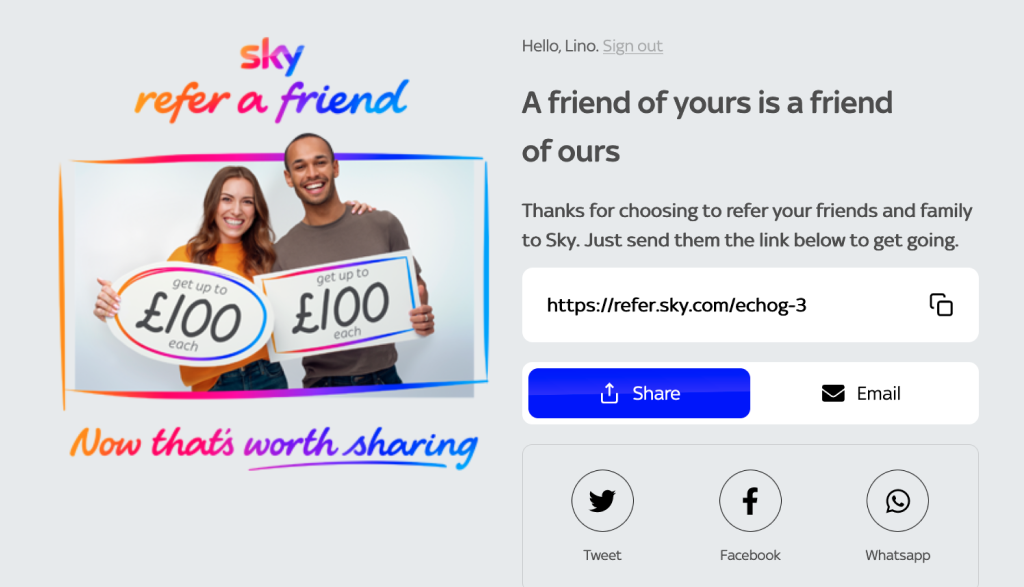
While the advantages of a referral link are that these can be easily shared by the referrer in a simple click using native integrations, and the friend just has to click on the link to find the offer. This of course does mean that the friend will require access to computer or mobile phone where they can find the link, or that the link is easy to remember. This can be helped by incorporating both the brand and a memorable work or name in the link like company.com/refer/mikejones77.
Another advantage of a referral link is that the link can lead to a personalized landing page which contains the name of the referrer, reinforcing personalization, restates the offer, sells the merits of the brand or service and includes CTAs and other pertinent information, such as that the offer is only available until a certain date.
Referral links also often allow for more in-depth analytics using tracking cookies as the referrer is identified as soon as the friend lands on the website, and referred-in friend’s journey can often subsequently be matched back once checks out occurs. Whereas, with a referral code the fact that a person has been referred is only identified once the code is applied, often at the end of the check out.
However, the reliance on cookies can be a weakness for referral links where third party cookies are used due to the policies of brands like Apple, with its Intelligent Tracking Prevention (ITP), or where laws and regulations prevent the use of cookie tracking without full consent.
While you’d be advised to keep the URL as short as possible to make it easier to remember, you may be able to use a URL shortener if you need to add more parameters or a QR code. In particular, a QR code can allow you to use the referral link for offline referrals where the store has the ability to scan these and report the information back to the referral program.

Finally, similar to referral codes, it can be possible to allow referrals to be credited after the conversion. Here the referred-in friend typically has to submit proof of purchase, such as an invoice or order number, and the details of the referrer.
In summary:
The advantages of referral links:
The main advantages are that they:
- Are easy to share, often just with a simple click
- Only require the referred-in friend to click on the link and complete the action
- Can be personalized with the referrer’s name and the brand
- Can lead to a purpose built landing page that contains the referrer’s name, restates the offer and contains convincing CTAs
- Are often more integrated with tracking systems, allowing for more detailed analytics
- Can be used for offline referrals with QR codes
- Can be applied after purchase to receive the reward after purchase
- Allow bad actors to be blocked by blocking the URL
The disadvantages of referral links:
The main disadvantages are that they:
- Normally require the friend to have access to the link to click through to the program online, unless the link is easy to remember
- Require cookies to be present on the website where the checkout occurs, which can be an issue if using third party cookies
- Unless a QR code is used, can be difficult to use offline
- Can be difficult to use with a call center
Which is better?
Your choice may depend on your circumstances. For example, if you expect to drive a lot of purchases in-store then, unless you expect to use QR codes, a referral code may be the better choice, particularly if your code is compatible with the tills used in-store. Similarly, it you expect to have issues with the acceptance of cookies, then referral codes may be a better choice.
But often issues such as the user experience for the friend, the ability to drive the user to a compelling landing page and the need to access detailed data and analytics, may lead you to lean to referral links.
However, many referral platforms let referrers choose between sharing by a link or code, so you can decide to offer both options and let your users decide.
Best Practices
Some best practices for referral codes include:
- Make the code as short as possible and easy to remember, no longer than necessary to be unique
- Personalize the code wherever possible, as it can make it easier to remember and the referrer’s name can help increase conversion rates
- Make the code case insensitive and don’t use characters that can be confused like O’s, zeros, ones, capital I’s, or lower case L’s in case the code needs to be typed or spoken
- Use a consistent format across all campaigns
Some best practices for referral links include:
- Make the link as short as possible so it’s easier to remember and is less likely to break if copied and pasted
- Personalize the link with the brand and name of the referrer
- Create a personalized landing page that maintains the referrer’s name, sells the product and has compelling CTAs
- Use QR codes if you expect conversion to happen instore
Next Steps
Hopefully, this helped explain the difference between your referral codes and referral links and helped you understand which is the most suitable for your referral program. If you’re interested in learning more about referral you can consult our FAQs or get in touch with one of our referral experts. We’d love to chat.